
Dodge Viper RT/10 - The Stuff of Legends
Few cars in Dodge Viper history have commanded more attention than the one that started it all – the 1992 Dodge Viper RT/10. Raw, unfiltered, and unapologetically American, the original Viper rewrote the rules of what a domestic sports car could be.
Where the Idea Was Born
The story of Dodge Viper history begins in 1988, inside Chrysler’s Advanced Design Studios. Chrysler President Bob Lutz and Chief of Design Tom Gale hatched the idea for a modern-day Shelby Cobra – a street-legal sports car that was all performance and nothing else.
Carroll Shelby himself was brought in to help shape the vision. His guiding philosophy was simple: massive power, minimal weight, zero compromise.
A clay model was completed within months, and by January 1989, the concept debuted at the North American International Auto Show in Detroit. The public reaction was immediate and overwhelming – orders began flowing before the show even ended.
Building the Viper: Team Viper Takes the Wheel
With public enthusiasm confirmed, Chrysler gave the green light. Chief engineer Roy Sjoberg assembled an elite group of 85 engineers – a unit that would become known as “Team Viper.” Full development began in March 1989.
The entire program ran on a budget of just $70 million, modest by Detroit standards and a fraction of what rivals spent. That lean approach helped shape the Viper’s no-frills identity from the very beginning.
By February 1990, the V10 engine was ready. And in May 1990, Lee Iacocca gave the project his official approval.
The 1991 Indy 500: A Star-Making Moment
Before the first Dodge Viper RT/10 reached a showroom, the car made one of the most memorable entrances in motorsport history. In 1991, Carroll Shelby piloted a pre-production Viper as the pace car for the Indianapolis 500 – a stroke of marketing genius that introduced the car to millions of racing fans at once.
The original choice had been the Dodge Stealth, but United Auto Workers complaints over the Japanese-built platform led organizers to substitute the all-American Viper. It was a happy accident that cemented the car’s legendary status before a single customer took delivery.
The 1992 Dodge Viper RT/10: The First Model Year
The 1992 Dodge Viper RT/10 went on sale in January 1992, and it was unlike anything else on the road.
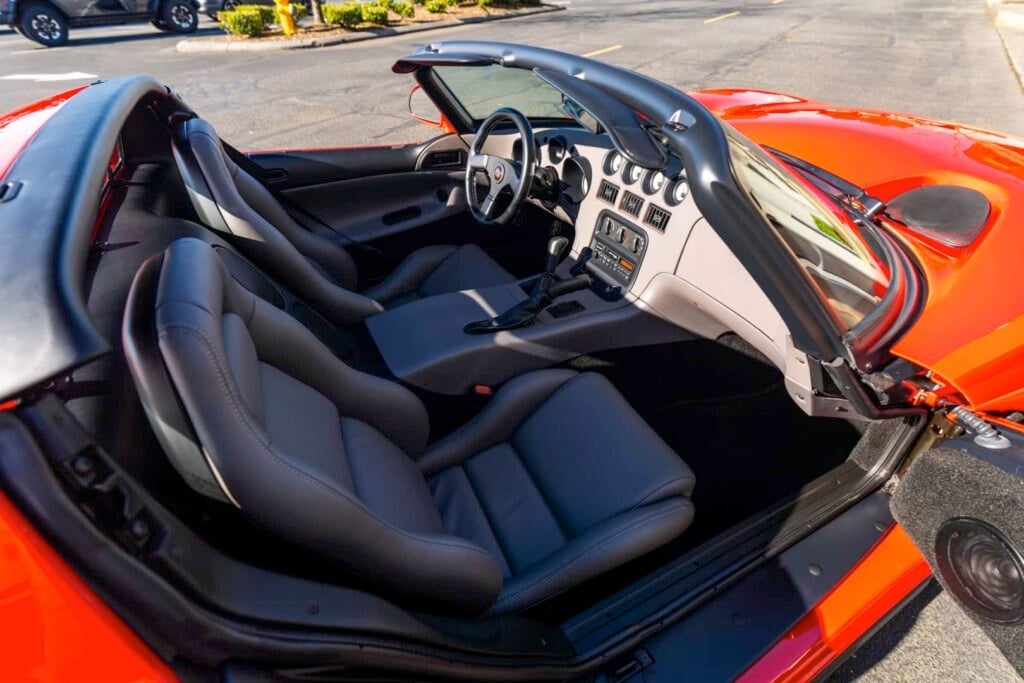
Dodge built just 285 Vipers for the 1992 model year, making them among the most collectible cars in American automotive history. Every single one rolled off the line at the New Mack Assembly Plant in Detroit in the same specification: classic red over gray.
The 1992 RT/10 came stripped to the bone. There were no exterior door handles, no air conditioning, no ABS, no traction control, and no airbags. The “windows” were vinyl panels with zippers. A canvas top offered minimal weather protection. Creature comforts were not part of the equation.
What it did have was one of the most spectacular engines ever shoehorned into a street car.
The 8.0L V10: Heart of the Beast
The Viper RT/10 was powered by an all-aluminum 8.0L V10 engine, developed in collaboration with Lamborghini – then a Chrysler subsidiary. The engine displaced 487.6 cubic inches and produced 400 horsepower at 4,600 rpm and 465 lb-ft of torque at 3,600 rpm.
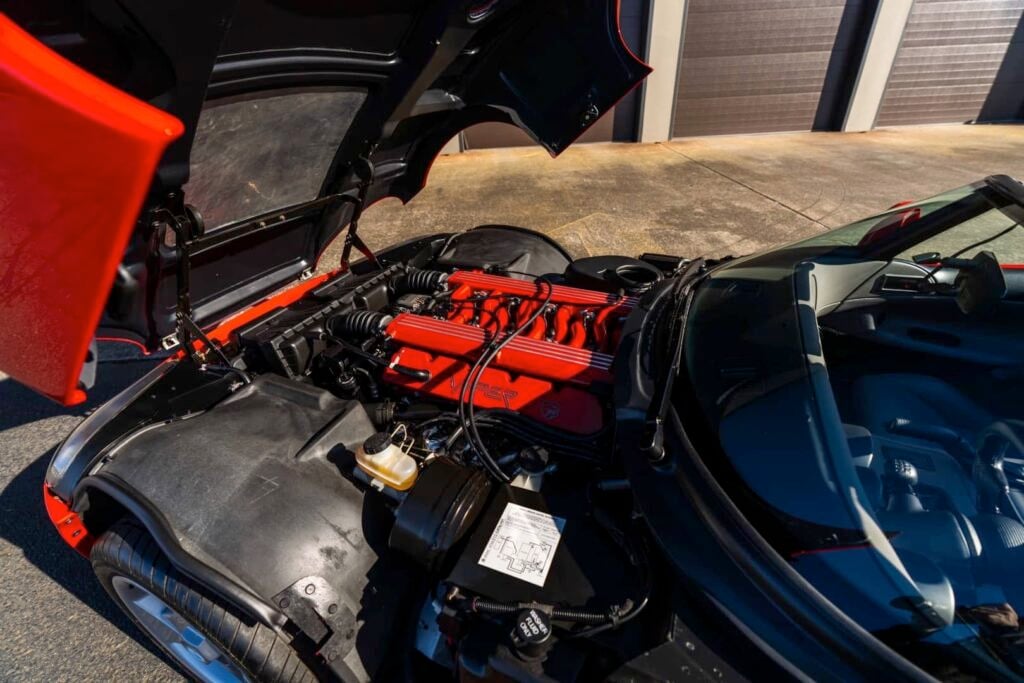
Power went exclusively to the rear wheels through a six-speed BorgWarner T56 manual gearbox – the only transmission offered throughout the car’s entire production life.
The results were breathtaking. The 1992 RT/10 could blast from 0 to 60 mph in approximately 4.4 seconds, cover the quarter mile in about 12.9 seconds, and reach a top speed of around 165 mph. For a domestic sports car in 1992, those numbers were sensational.
No Safety Net: The "Widowmaker" Reputation
The absence of electronic driver aids earned the early Dodge Viper RT/10 a now-famous nickname: the Widowmaker.
With nearly 500 lb-ft of torque channeled to the rear wheels through a chassis with no traction control or ABS, the Viper demanded respect and skill. It rewarded talented drivers with an exhilarating, analog experience unavailable elsewhere. It punished the careless without mercy.
That unfiltered character was intentional. The Viper was never meant to coddle its driver – it was built to challenge them.
First-Generation Viper: 1992-2002
The first-generation Dodge Viper, designated the SR series, ran from 1992 through 2002. The initial SR I iteration covered model years 1992-1995, with the RT/10 Roadster as the sole body style.
The SR II arrived in 1996 alongside the iconic GTS Coupe with its “double-bubble” roof and Shelby-inspired blue-and-white racing stripes. Updates over the decade brought modest power increases and refinements, but the core spirit – massive V10, rear-wheel drive, six-speed manual, no apologies – never wavered.
Collector Car Value: What a First-Gen Viper Is Worth Today
The first-generation Dodge Viper has quietly become one of the most compelling collector car investments in the American sports car market. Production ended in 2017, and values have been trending steadily upward as enthusiasts recognize just how significant – and how scarce – early examples really are.
According to Hagerty’s Valuation Tool, a 1992 Dodge Viper RT/10 in excellent (#2) condition is currently valued at approximately $49,400. First-generation Vipers as a whole (1992-1995) in excellent condition range between $37,700 and $74,000, depending on mileage, originality, and documentation.
The 1992 model year commands a clear premium over later SR I cars. The reason is straightforward: with only 285 units produced, the 1992 RT/10 is significantly rarer than 1993, 1994, and 1995 cars. That scarcity, combined with strong demand for first-year examples, consistently pushes prices above the broader first-gen average.
Recent Auction Results Tell the Story
Recent auction results illustrate just how wide the value range can be – and how dramatically low mileage moves the needle.
In August 2025, a 27-mile, never-driven 1992 RT/10 sold on Bring a Trailer for $100,000 – more than double its original $53,300 window sticker price. That same week, a 9,000-mile driver-quality 1992 example sold, also on Bring a Trailer, for $65,500.
The ceiling is even higher for truly exceptional specimens. Chassis No. 100 – a 40-mile 1992 RT/10 – was offered at RM Sotheby’s with a pre-sale estimate of $135,000-$155,000. The highest recorded sale for any first-generation Viper on Bring a Trailer was $170,000, achieved by a 1992 example at auction in January 2023.
Coming Up: Two First-Gen Vipers at Mecum Indianapolis 2026
One of the most closely watched Viper opportunities of the year is set for Dana Mecum’s 39th Annual Spring Classic, running May 8-16, 2026, at the Indiana State Fairgrounds in Indianapolis. Two pristine first-generation RT/10 Roadsters will cross the block – and both are offered with no reserve.
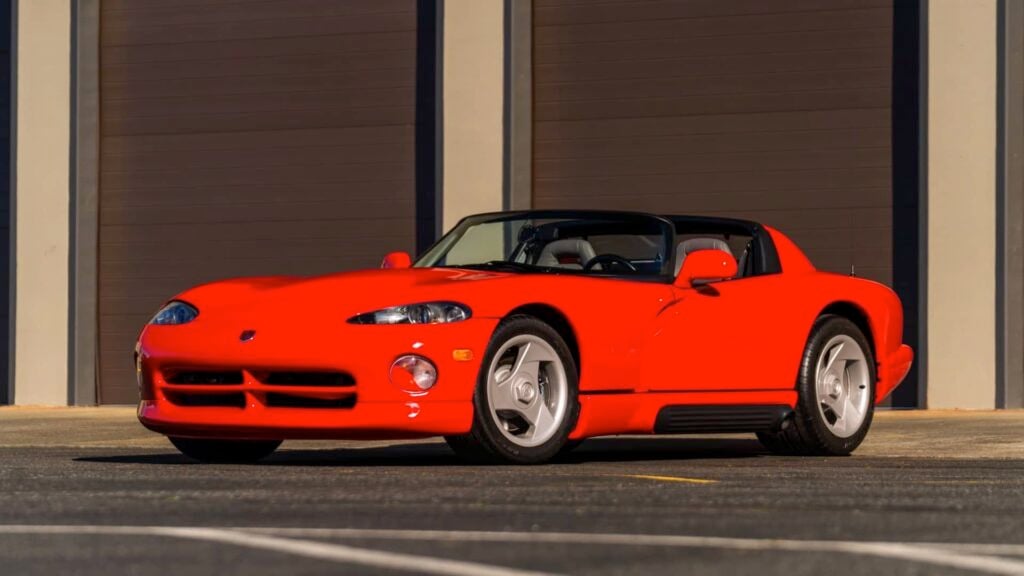
The headline lot is a 1992 Dodge Viper RT/10 (Lot S170) showing just 29 miles from new – a virtually undriven example representing the rarest model year in the entire Viper production run. With no reserve and a 1992 build date, this car has the combination of factors that consistently draws serious collector attention and top-tier results.
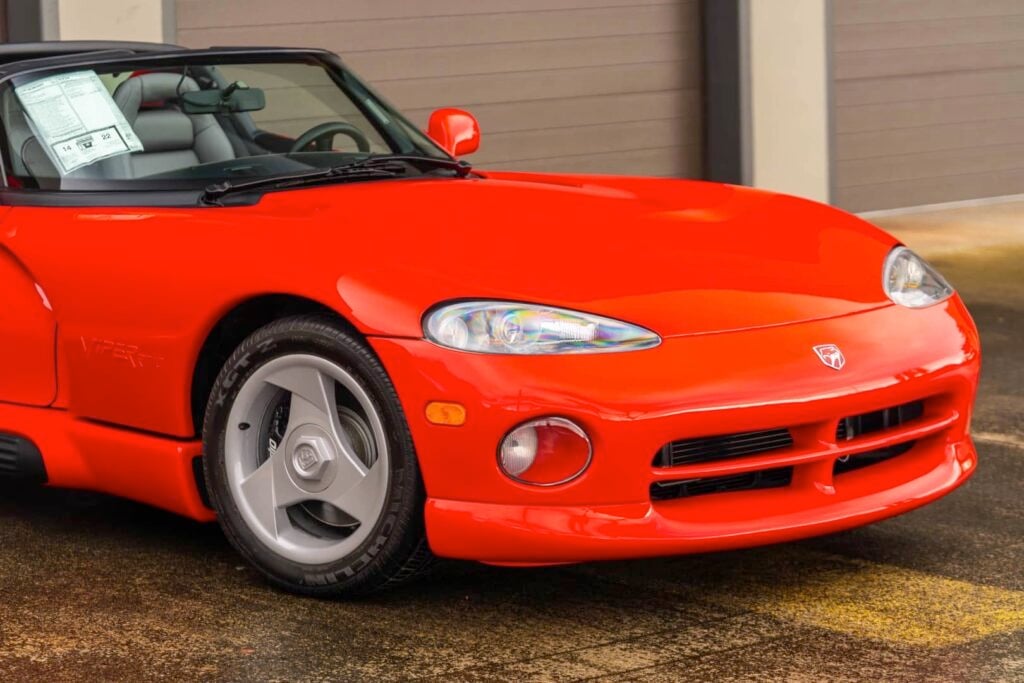
Immediately alongside it is a 1994 Dodge Viper RT/10 (Lot S171) with only 34 miles on the odometer. While the 1994 model year was produced in higher numbers than the 1992, this car’s near-zero mileage places it firmly in time-capsule territory.
The no-reserve format on both cars means the auction will produce a genuine market result – and given recent comps for ultra-low-mileage first-gen Vipers, both lots are worth watching closely.
Predicted Hammer Prices
Based on recent comparable sales and adjustments for platform, format, and the Mecum live floor environment, here is our outlook for both lots. These are collector market estimates, not financial advice.
1992 RT/10 (29 miles) – Predicted Range: $100,000-$125,000, most likely $108,000-$115,000
The closest comparable is a 27-mile 1992 RT/10 that sold on Bring a Trailer in August 2025 for $100,000 – nearly identical mileage and the most recent true apples-to-apples sale. Mecum’s live floor consistently amplifies competitive bidding on Mopar icons, typically adding a 5-12% premium over BaT results. The no-reserve format keeps paddles moving, and the 1992 scarcity premium is firmly intact. The RM Sotheby’s estimate of $135,000-$155,000 on a comparable 40-mile example suggests meaningful upside with the right crowd.
1994 RT/10 (34 miles) – Predicted Range: $65,000-$90,000, most likely $72,000-$82,000
The freshest 1994 comp is a ~746-mile example that brought $55,055 on Bring a Trailer in March 2026. Applying the ultra-low-mileage premium observable across 1992 data – roughly 60% over driver-grade cars – implies a 34-mile 1994 in the $72,000-$88,000 range before any live-floor adjustment. The 1994 does not carry the first-year scarcity premium of the 1992, but bidders priced out of the headline lot may redirect competitive energy to this car, providing meaningful support at the floor.
What Drives Value
Several factors determine where a first-gen RT/10 lands on the spectrum:
- Mileage: Ultra-low-mileage examples (under 500 miles) can fetch two to three times what a driver-quality car brings
- Documentation: Window stickers, factory invoices, owner’s manuals, and Carfax history significantly boost value
- Originality: Unmodified cars with matching-numbers drivetrains command the strongest prices
- Build sequence: Low-production-number cars (the earliest off the line) attract premium collector interest
A Solid Investment Outlook
With approximately 32,000 total Vipers built over 26 years – and production now permanently ended – supply can only decrease over time. The 1992 RT/10, with its tiny run of 285 cars, sits at the top of the desirability ladder among first-gen buyers.
For collectors who prioritize rarity, raw character, and American automotive history, the 1992 Dodge Viper RT/10 remains one of the most rewarding collector cars available at its price point.
Legacy of the 1992 Dodge Viper RT/10
The 1992 Dodge Viper RT/10 is widely credited with reigniting American performance car culture. It proved that a domestic automaker could build a world-class sports car on a fraction of the budget of European rivals.
Those original 285 first-year cars remain highly prized by collectors today, a tangible piece of Dodge Viper history that changed the automotive landscape forever.
The Viper’s DNA – outrageous power, minimal interference, and pure driving engagement – echoed through every generation that followed, all the way through the car’s final production year in 2017.