
Gooding Christie's Retromobile Paris Historic Debut
Gooding & Company’s 2025 merger with Christie’s has set the stage for a defining moment in European collector car scene. On January 29, 2026, Gooding Christie’s will conduct its inaugural European sale as the official auction house of Retromobile, marking not only the auction house’s first transatlantic venture but also a pivotal chapter in the marriage of two prestigious institutions. Taking place in Pavilion 7.1 at Paris Expo Porte de Versailles during the 50th anniversary edition of the world-renowned automotive event, this sale arrives with exceptional ambitions and a carefully curated lineup of 85 lots spanning more than 120 years of automotive history.
The significance of this moment extends beyond logistics. As Rupert Banner, senior specialist and head of sale at Gooding Christie’s, explains, “Rétromobile is essentially Art Basel for the car world. It’s a wonderful convergence of manufacturers, dealers, restorers, collectors and enthusiasts.” The partnership represents a strategic alignment of two auction powerhouses entering a market where European buyers, particularly those transacting within the European Union, now have unparalleled access to global bidding infrastructure. This first French auction presents a template for what could become a significant pillar of Gooding Christie’s international operations, leveraging Christie’s established European networks while maintaining Gooding’s legendary expertise in high-end collector vehicles.
The catalogue itself reflects meticulous curation. While the sale encompasses vehicles ranging from pre-war Grand Prix machines to cutting-edge track-only hypercars, the emphasis clearly tilts toward Ferrari – a deliberate strategy that positions the house as custodian of Maranello’s most significant creations. Among the 85 lots, fifteen are Ferraris, each telling a distinct chapter in the marque’s eight-decade evolution. Yet it is three vehicles in particular that deserve scrutiny from serious collectors: the 1960 Ferrari 250 GT SWB Berlinetta, the 1984 Ferrari 288 GTO, and the 1971 Lamborghini Miura P400 SV. Each represents not just a desirable automobile but an inflection point in supercar history.
1960 Ferrari 250 GT SWB Berlinetta: Golden-Era Authenticity and Provenance
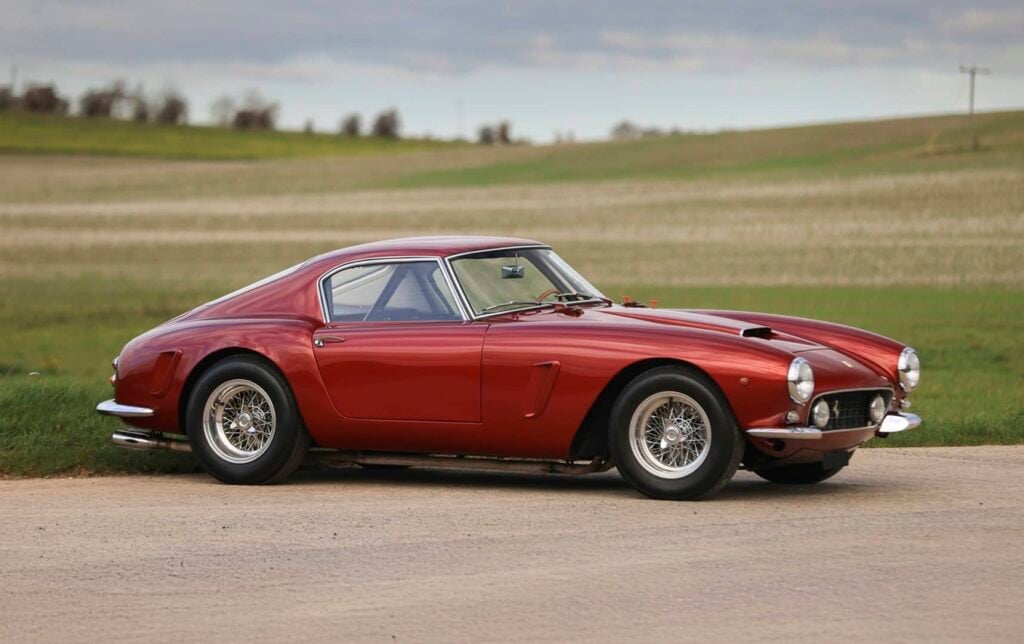
Chassis 2177 GT commands the sale as Lot 1, with an estimate of €8,000,000 – €9,000,000, a figure that underscores both its historical significance and market positioning. This early-production, semi-competition Berlinetta embodies everything Ferrari stood for during the 1960s: purposeful design, competition pedigree, and engineering coherence. Beneath its graceful Scaglietti coachwork lies a matching-numbers 3.0L Colombo V12 engine, a fundamental requirement for collectors prioritizing authenticity and originality.
What elevates this particular 250 GT SWB beyond typical examples is its exhibition history and documented provenance. In 1997, Ferrari selected it for its 50th anniversary celebrations in Rome and Maranello, a curatorial decision that speaks to its original condition and historical importance. Two decades later, the factory again showcased the car at Ferrari’s 70th anniversary festivities at Fiorano. Such selections are not arbitrary; they reflect Ferrari’s own recognition of authenticity and significance. As Banner notes, “Ferrari would only showcase the best of the best at these events.”
Beyond these ceremonial appearances lies a thoughtful ownership history. The car spent years in the Swiss collection of Dr. Peter Baumberger before passing to Jean-Robert Grellet, an Austrian enthusiast who drove it actively in premier historic rallies including the Ennstal-Classic, Giro di Sicilia/Targa Florio Revival, and Grand Prix de Montreux. Rather than remaining garage-kept, this Berlinetta has enjoyed genuine use by custodians of significant taste and means. For collectors evaluating the golden-era Ferrari market, where competition and rarity command premium valuations, 2177 GT presents an increasingly rare opportunity: a matching-numbers example with documentary evidence of its significance, original condition verified through exhibition, and authentic driving history rather than competition-focused provenance or museum stasis.

The 1984 Ferrari 288 GTO: 1980s Supercar Innovation and Rarity
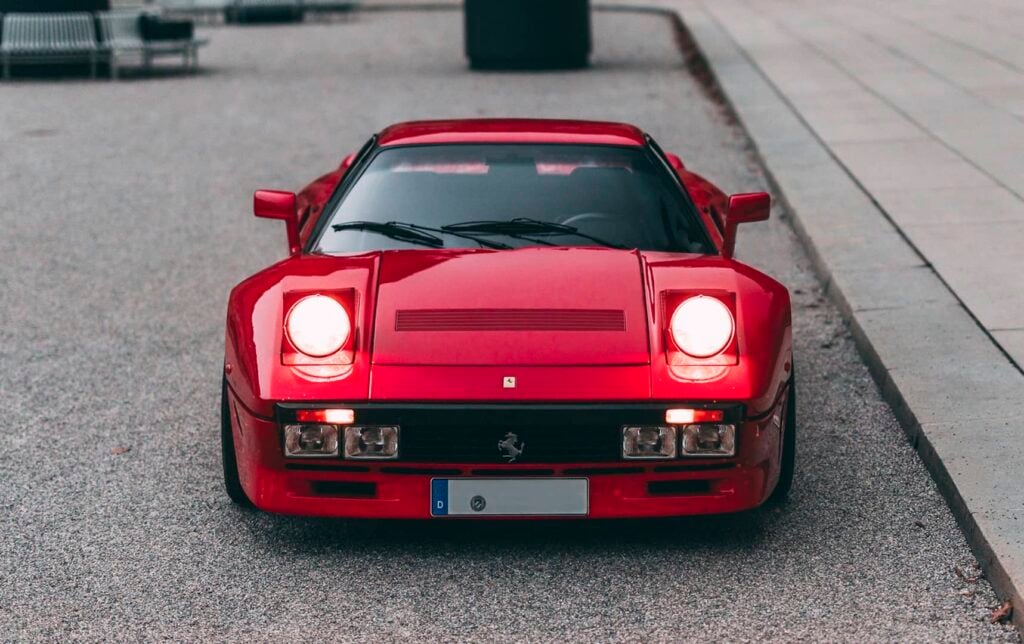
The 1984 Ferrari 288 GTO (Lot 67) represents a different chapter in Ferrari’s lineage – not the golden age but the turbocharged transition that bridged Maranello’s competition heritage with its modern supercar identity. Estimated at €6,000,000 – €7,000,000, this machine stands as one of only 272 examples produced, a production figure that underscores its exclusivity.
The 288 GTO’s conception during the early 1980s reflected Ferrari’s participation in Group B racing, a category that briefly promised unbridled speed before geopolitical concerns and safety crises curtailed the initiative. The factory engineered the 288 GTO as a homologation special – a road-legal variant capable of delivering competition performance while remaining usable on public streets. Its tipo F114B twin-turbocharged 2.8L V8 produces 400 horsepower, a figure that represented genuine supercar territory in the 1980s, when turbocharged engines remained exotic and twin-turbo configurations were engineering statements rather than marketing increments.
What distinguishes the example offered in Paris is its exceptional preservation. The odometer reveals just over 1,500 kilometers – a figure that suggests judicious storage and minimal use rather than neglect. The Classiche Red Book certification confirms original specifications and meeting factory tolerances. Furnished with original manuals and tool kit, accompanied by period documentation, this 288 GTO appeals specifically to collectors valuing nostalgia combined with originality. As Rupert Banner observed in recent commentary on market trends, “We’re also seeing a growth in nostalgic cars from the 1980s and 1990 – the sorts of machines people had posters of on their bedroom walls as teenagers.” The 288 GTO’s wedge profile, Kevlar body panels, and turbocharged aggression make it a poster car par excellence, a machine that crystallizes an aesthetic moment while delivering engineering substance.
1971 Lamborghini Miura P400 SV: The Ultimate Expression of Mid-Engine Rebellion
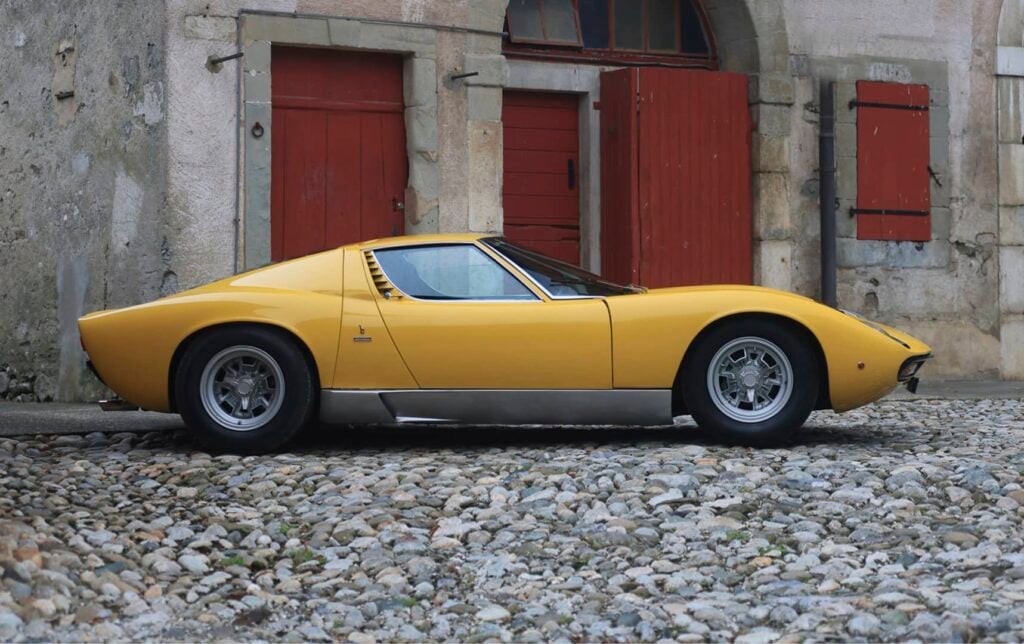
Lot 19, the 1971 Lamborghini Miura P400 SV (chassis 4908), carries an estimate of €3,250,000 – €3,750,000 and represents the final evolution of what many consider the automotive world’s most iconoclastic supercar. Lamborghini revealed the Miura’s astonishing chassis at the 1965 Turin Motor Show – a transparent display of transverse – V12, five-speed transaxle, fully independent suspension, and four-wheel disc brakes that announced a radical reimagining of performance car architecture.
Only 150 P400 SV examples were manufactured between 1971 and 1973, rendering them less than one-fifth of total Miura production and placing them at the apex of 1970s supercar desirability. The SV represented the model at absolute maturity: reinforced chassis, redesigned rear suspension for stability, flared arches, ventilated brakes, and engine output increased to a quoted 385 horsepower at 7,850 rpm. The transformation was profound – faster, more composed, and more mature than earlier Miuras without sacrificing the outrageous style that defined the marque.
Chassis 4908 carries particular significance within that elite cohort. Completed July 29, 1971, it was delivered new to Switzerland in its striking original color scheme of Giallo Fly (Fly Yellow) over black vinyl with blue cloth inserts – a striking European specification that retains matching-numbers engine (30650) and correctly stamped Bertone body panels (746). For more than 25 years, it has remained in discrete Swiss private ownership, displayed briefly in a Geneva museum before being kept largely out of public view. At cataloguing, its odometer displayed just 25,553 kilometers, consistent with measured ownership and genuine preservation rather than warehouse hibernation.
The Auction in Context
The Gooding Christie’s Rétromobile sale arrives at a moment when collector car valuations remain robust, when provenance and originality command premium positioning, and when European buyers increasingly access global auction platforms. The 1960 Ferrari 250 GT SWB Berlinetta, the 1984 Ferrari 288 GTO, and the 1971 Lamborghini Miura P400 SV collectively represent three distinct chapters in supercar evolution: golden-era competition heritage, turbocharged innovation, and mid-engine revolution. For serious collectors, historians, and market observers, January 29 offers not merely an auction but a masterclass in authenticity, preservation, and automotive significance.