
Pagani Huayra: History, Legacy, and Auction Impact
Few machines in modern automotive history have commanded the reverence – and the financial gravity – of the Pagani Huayra. Born from the imagination of Argentine-born Italian craftsman Horacio Pagani, the Huayra arrived in 2011 as the successor to the iconic Zonda and immediately redefined what a handcrafted hypercar could be.
Over more than a decade, the Huayra evolved through a series of breathtaking variants – each more exclusive than the last. Today, Pagani Huayra auction results consistently set new records, and a fresh example is headed to Barrett-Jackson’s Palm Beach 2026 event.
Eight Years in the Making
The Huayra project began in 2003, when Horacio Pagani started conceiving a clean-sheet successor to the Zonda. The name derives from Wayra Tata, the Quechua wind god – a tribute to a car engineered around the mastery of aerodynamic forces.
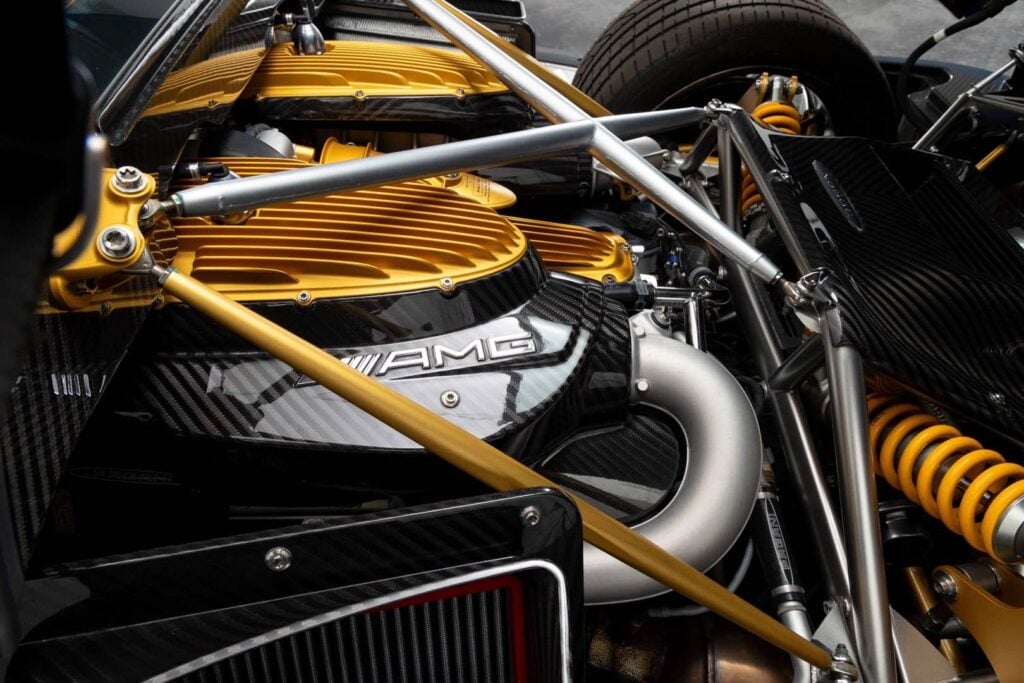
At its heart sits a bespoke 6.0L, twin-turbocharged V12 built exclusively for Pagani by Mercedes-AMG, producing approximately 700 horsepower and 737 lb-ft of torque. Critically, the supply agreement with AMG capped total production at just 100 units. That hard production limit became one of the most powerful drivers of Pagani Huayra price appreciation ever seen in the hypercar market.
Unveiled at the 2011 Geneva Motor Show, the Huayra earned instant acclaim. Top Gear magazine named it “The Hypercar of the Year 2012”. Four active aerodynamic flaps, a carbo-titanium monocoque chassis, and a curb weight of just 1,350 kg placed it at the pinnacle of road car engineering.
Deliveries began in 2012 – 2013 at approximately $1.2 – $1.4 million. Pagani had already secured orders for 105 cars before the first example left the factory.
The Huayra Variants
Pagani expanded the Huayra into a family of increasingly rare and powerful models. Each new variant pushed the Pagani Huayra price ceiling higher:
- Huayra BC (2016): Named after Pagani’s late friend and first customer Benny Caiola. Limited to 30 units with upgraded aero and power.
- Huayra Roadster (2017): A fully open-top variant, again capped at 100 units.
- Huayra Roadster BC (2019): Just 40 examples built, producing 791 hp and over 1,100 lbs of downforce at speed. Base price approximately $3.5 million.
- Huayra Imola (2019): Only five units produced, priced from $5.4 million.
- Huayra Codalunga (2022): Five coachbuilt long-tail examples at €7 million each – all sold before the public reveal.
Pagani Huayra Auction History: Consistent Strong Auction Results
The Huayra’s secondary market story is defined by consistent, dramatic appreciation. Collectors looking to track the Pagani Huayra auction market will find a remarkably clear upward trend.
2016 – 2018: Establishing the Baseline
The first coupés to appear at auction set a trading range of roughly $1.85 – $2.5 million – already a premium over original MSRP. A 2014 Huayra sold for $2,035,000 at RM Sotheby’s Amelia Island in 2016, while a bespoke 2014 Huayra Tempesta fetched $2,420,000 at RM Sotheby’s Monterey in 2017.
2020: Pandemic-Era Strength
RM Sotheby’s online-only “SHIFT/Monterey” sale in August 2020 – the largest online-only collector car auction of its kind at the time – saw a low-mileage 2014 Huayra achieve $1,848,000, proving that institutional confidence in the car’s value held firm even in a disrupted market.
2022 – 2024: Values Climbing
A 2016 Huayra sold for $2,117,500 at Mecum Kissimmee 2022. The market’s most dramatic Pagani Huayra auction result followed at RM Sotheby’s Dubai in December 2024, when a 2017 Huayra BC Coupé in Tempesta specification hammered at $4,336,250.
2026: A New U.S. Benchmark
In January 2026, a 2014 Pagani Huayra coupé achieved $3,327,500 at Mecum Kissimmee – more than double its original list price. The result placed the Huayra above a 1966 Shelby 427 Cobra ($3,300,000) and just below a 2022 Bugatti Chiron ($3,850,000) in the final results.
Spotlight: 2016 Pagani Huayra at Barrett-Jackson Palm Beach 2026
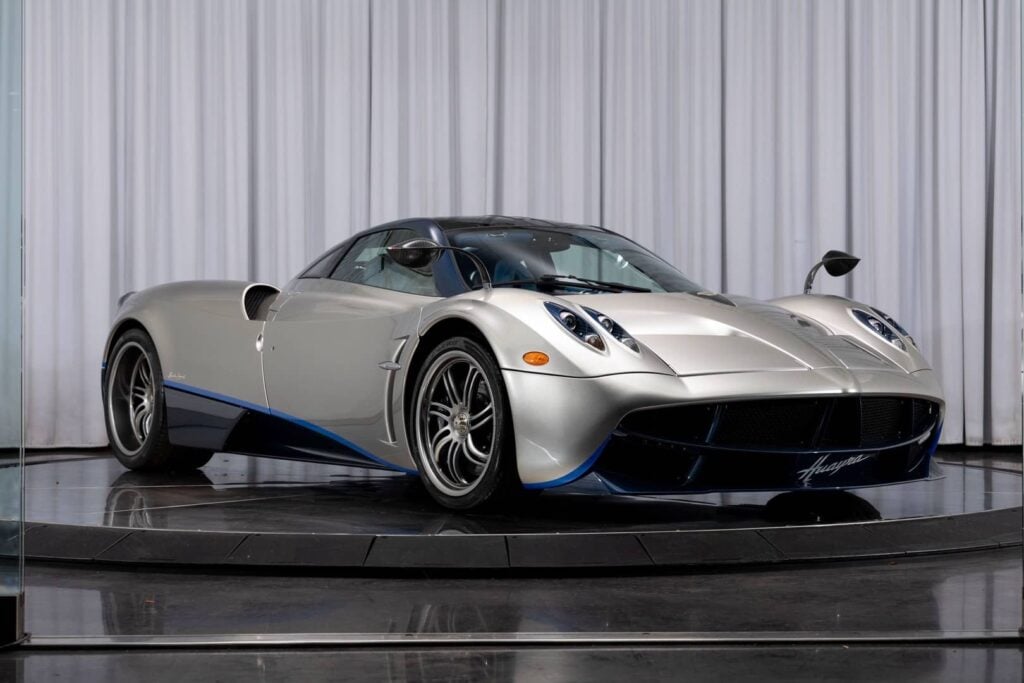
The latest chapter in the Pagani Huayra auction story is set to unfold at the South Florida Fairgrounds. Barrett-Jackson’s Palm Beach Auction – scheduled for April 16 – 18, 2026 – will offer a stunning 2016 Pagani Huayra on Super Saturday.
Barrett-Jackson Chairman and CEO Craig Jackson described the car as “a true masterpiece in exotic design and engineering.”
This example is one of just 100 Huayras ever built. Key highlights include:
- Engine: Mercedes-AMG M158 6.0-liter twin-turbo V12 – 730 hp, 738 lb-ft of torque from 2,250 – 4,500 rpm
- Transmission: Seven-speed sequential manual
- Exterior: Gray Clement finish
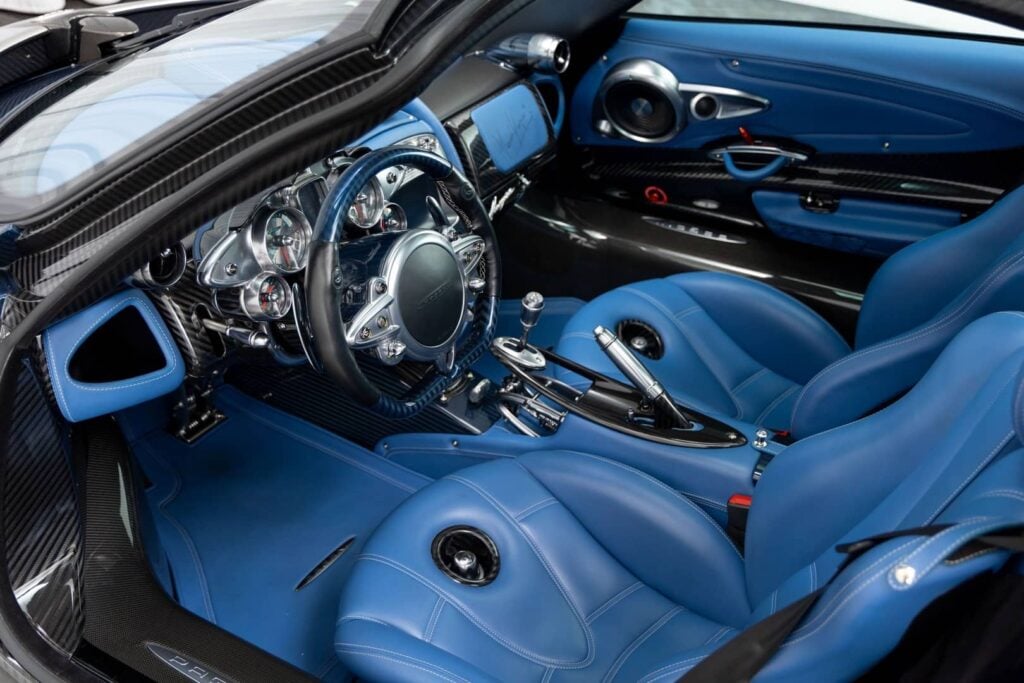
- Interior: Bespoke custom carbon fiber with hand-stitched leather upholstery
- Exhaust: Hydroformed joints and Inconel silencers for acoustic drama
For collectors tracking the Pagani Huayra auction market, this Palm Beach offering is a rare public opportunity. Standard-specification coupés from the original 100-car run seldom cross the block. With the Mecum Kissimmee 2026 result of $3,327,500 serving as the most recent comparable sale, the Barrett-Jackson Palm Beach 2026 Huayra carries significant weight as both a driver’s car and a tangible collector asset.
How the Huayra Has Shaped the Broader Hypercar Market
The Huayra’s auction success has validated a broader investment thesis across the hypercar category. The same Mecum Kissimmee 2026 event that produced the $3.3 million Huayra result also saw a 2015 Ferrari LaFerrari sell for $6,710,000 and a 2015 Porsche 918 Spyder Weissach achieve $6,050,000 – all products of the same Golden Era of limited-production hypercars (2012 – 2020), all appreciating along the same trajectory.
The Pagani Zonda – the Huayra’s direct predecessor – offers the clearest roadmap for where Huayra values may be headed. Zondas have appreciated by up to 23 times their original list price, with one example selling at auction for $11 million. Horacio Pagani himself repurchased a Zonda he had originally sold for $1.5 million, later paying $4.5 million – and the car is now estimated at $9 million.
With Huayra production now fully concluded, every future Pagani Huayra auction result reflects pure collector demand against a fixed, finite supply. If the Zonda’s trajectory is anything to go by, the Huayra has a long way to climb.