
Mercedes-Benz C111 - Never Intended for Public Sale
When Daimler-Benz unveiled a metallic rosé-orange wedge at the 1969 Frankfurt Motor Show, crowds reacted as if Stuttgart had landed a spacecraft on its stand. With gullwing doors recalling the 1954 300 SL and a mid-mounted Wankel rotary engine, the Mercedes-Benz C111 looked ready to challenge Ferrari and Lamborghini in showrooms.
Wealthy enthusiasts immediately mailed blank checks to Stuttgart, yet Daimler-Benz insisted there would never be a C111 for sale. Across a decade of testing from 1969 to 1979, the automaker built just 17 prototypes and rejected series production.
Instead, the C111 operated as a high-speed rolling laboratory testing rotary engines, turbodiesels, twin-turbo V8s, anti-lock brakes, and multi-link suspension. Nearly six decades later, a historic C111 auction at RM Sotheby’s Paris in February 2027 is finally placing a factory example into private hands.
Origins and Computer Design
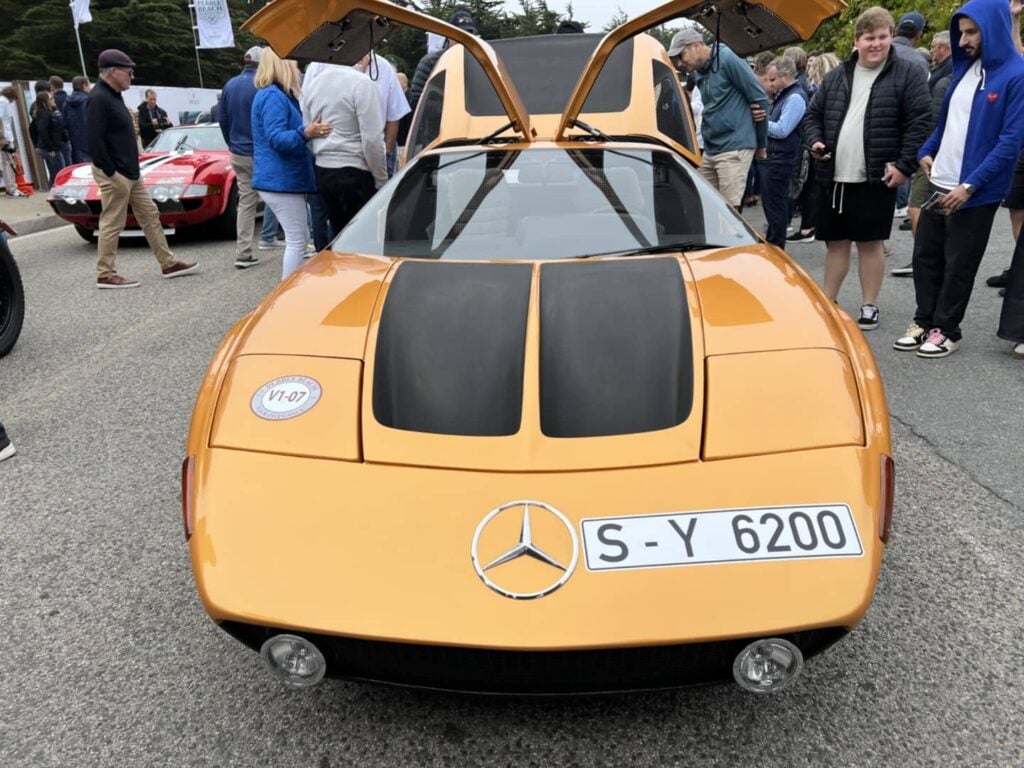
Attracted by the compact size, low weight, and turbine-like smoothness of Felix Wankel’s pistonless engine, Daimler-Benz licensed rotary technology from NSU in 1961. In late 1968, Passenger Car Development Chief Rudolf Uhlenhaut – father of the 300 SL – launched a mid-engine rotary coupe under code C 101, with pre-development led by Dr. Hans Liebold.
Styling management went to Bruno Sacco, working alongside Josef Gallitzendörfer and Peter Pfeiffer to shape glass-fiber-reinforced plastic bodywork bonded to a welded steel floor pan. Beneath the skin, engineers used an in-house software program called ESEM (Elasto-Static Elements-Method) to calculate dynamic chassis loads digitally.
Computer simulation trimmed four to six months off chassis development and earned the C111 its famous factory nickname, “The Car That Came from the Computer”. Uhlenhaut shook down the first complete prototype at the Hockenheimring on his birthday, July 15, 1969, and after Peugeot cited its trademark on three-digit names with a middle zero, Stuttgart renamed the car the Mercedes-Benz C111.
Five Versions of the C111
Over ten years, Mercedes-Benz built five distinct C111 iterations, evolving from rotary road-car prototypes into diesel and twin-turbo V8 land-speed streamliners.
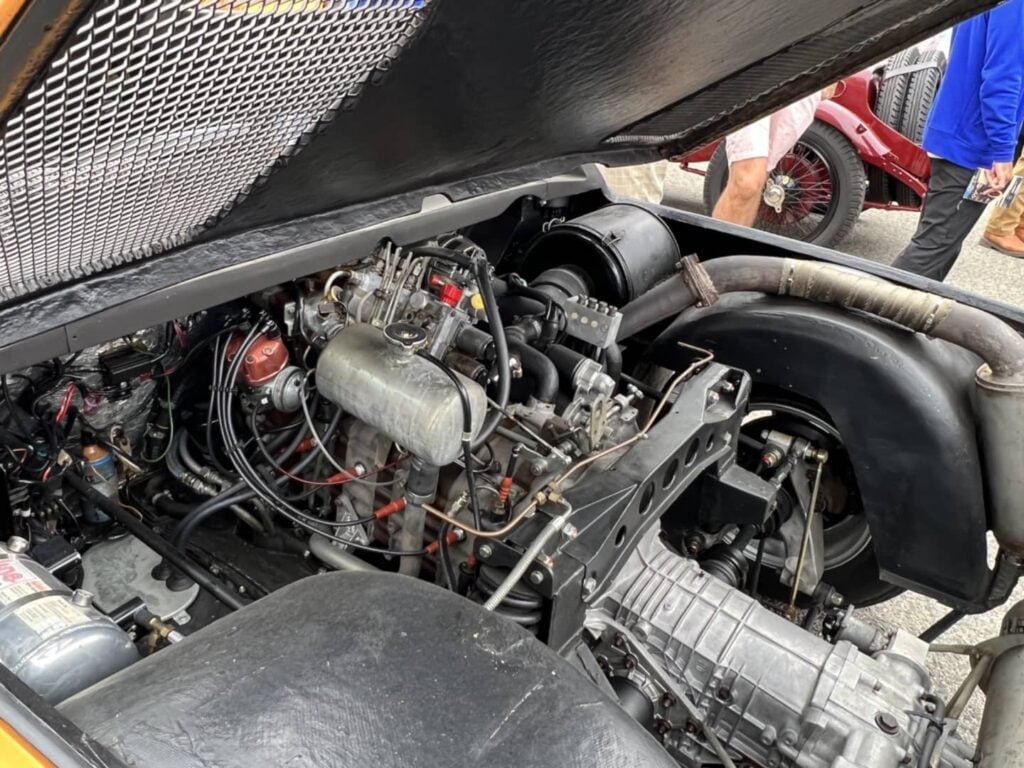
C111-I Three-Rotor Pioneer
Debuting in September 1969, the C111-I packed a direct-injected 1.8-liter M 950 F three-rotor Wankel – rated equivalent to 3.6 liters – making 280 PS (276 hp) for a 5.0-second 0–100 km/h sprint and a 260 km/h (162 mph) top speed. Higher sills, louvered rear buttresses, rectangular taillights, a 0.35 drag coefficient, and signature Weissherbst metallic rosé-orange paint defined this original coupe.
C111-II Four-Rotor Supercar
Unveiled at Geneva in March 1970, the C111-II added a fourth rotor to create the 2.4-liter (4.8-liter equivalent) M 950 W 48 making 350 PS (345 hp), launching the 1,240 kg car to 100 km/h in 4.8 seconds and on to 300 km/h (186 mph). Open rear buttresses, a lower beltline, round taillights, a 0.325 drag coefficient, and houndstooth seats gave it showroom polish.
Even so, the board voted against production in November 1971 after identifying 38 U.S. safety, bumper, and emissions hurdles the fiberglass rotary coupe couldn’t pass. High fuel consumption, rotor-seal wear, and the 1973 oil crisis ended Mercedes Wankel development by 1976.
C111-II D Turbodiesel Prototype
In 1976, Stuttgart converted the first C111-II chassis (Car 31) into the C111-II D, replacing the rotary with an intercooled, Garrett-turbocharged 3.0-liter OM 617 LA five-cylinder diesel boosted from 80 hp to 190 hp. Wearing faired-in headlamps and deleted mirrors, it ran nonstop for over 60 hours at Italy’s circular Nardò Ring, setting 16 speed records – including three absolute world records – above 251 km/h (156 mph).
C111-III Silver Streamliner
Built from scratch in 1977, the single-seat C111-III traded orange wedge bodywork for metallic silver, enclosed wheels, a longer wheelbase, and a single dorsal fin, achieving a record-low 0.183 drag coefficient. Powered by a 230 hp OM 617 LA turbodiesel with live cockpit telemetry, it captured nine absolute world records at Nardò in April 1978, averaging 316 to 322 km/h (196 to 200 mph) at nearly 15 mpg US.
C111-IV Twin-Turbo V8
Converting C111-III Car 41 into the one-off C111-IV for 1979, engineers installed a 4.8-liter M117 V8 with twin KKK turbochargers making 500 PS (493 hp) alongside twin rear tailfins and dual spoilers. On May 5, 1979, Dr. Hans Liebold lapped Nardò at 403.978 km/h (251.02 mph), beating Mark Donohue’s Porsche 917/30 record as the first car past 400 km/h on a closed circuit.
Impact on Mercedes-Benz Road Cars
Few prototypes shaped more showroom hardware than the Mercedes-Benz C111. Its Nardò endurance runs validated oil-cooled pistons and sodium-filled valves on the OM 617, launching the 1978 W116 300 SD – the world’s first production turbodiesel luxury sedan.
Its experimental rear axle evolved into the five-link independent rear suspension introduced on the 1982 W201 190 and later used across the W124 and R129 SL. Test cars also advanced early Teldix and Bosch ABS, crash-cell engineering, and the four-spoke safety steering wheel while inspiring the 1991 V12 C112 and 2023 electric Vision One-Eleven.
First Mercedes-Benz C111 Auction
Immortalized in Andy Warhol’s 1986 “Cars” silkscreens, all 13 surviving C111 prototypes have remained factory-owned for nearly six decades. On November 18, 2026, Stuttgart finally announced the first C111 for sale, consigning 1970 C111-II Car 33 to RM Sotheby’s Paris at the Palais du Louvre on February 3, 2027.
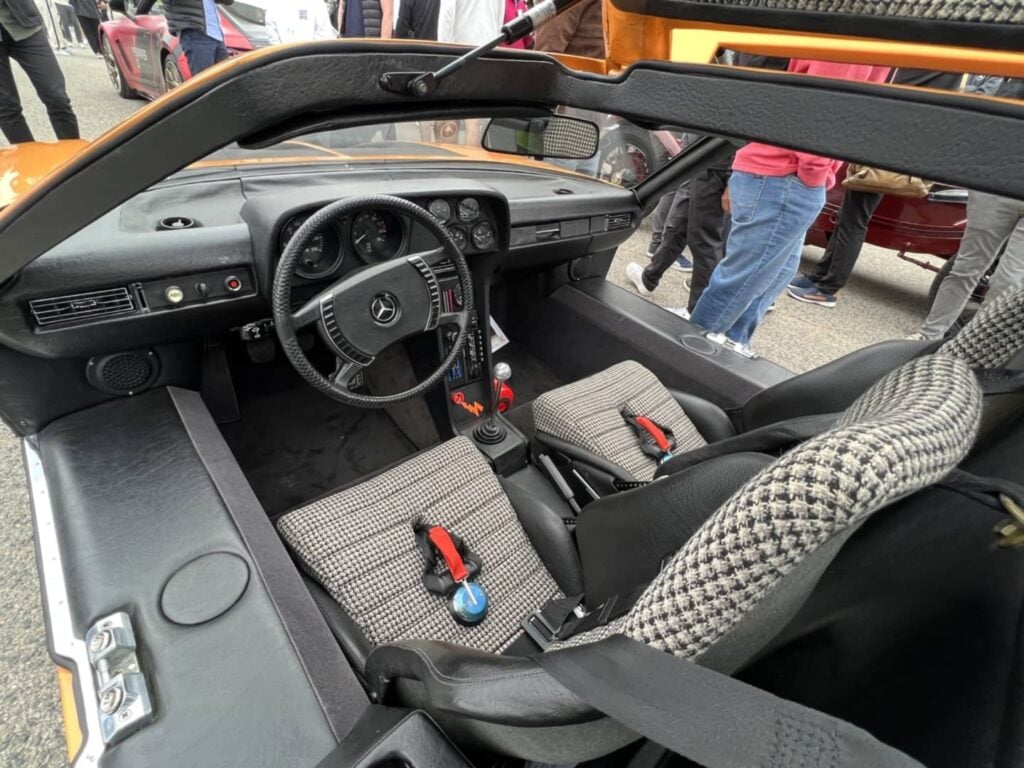
Estimated in excess of €25 million ($27.5 million), Car 33 comes with a contractual pledge not to sell another factory C111 for at least 25 years. Powered by its drivable 350 PS four-rotor Wankel and showing 24,766 kilometers, it handled Hockenheim runs, Uhlenhaut’s luggage “butter test”, and a 1971 drive by conductor Herbert von Karajan before its 2024 Pebble Beach recommissioning.
Following RM Sotheby’s $142 million sale of the 1955 300 SLR Uhlenhaut Coupé in 2022, proceeds from this landmark C111 auction will fund “Mercedes-Benz Museum 2.0” and its global interactive digital twin – turning the supercar Stuttgart refused to sell in 1969 into a lasting investment in its heritage.