
Aston Martin DB4 History Overview
The Aston Martin DB4 debuted at the London Motor Show in October 1958. It was the first all-new Aston Martin developed under owner Sir David Brown.
The DB4 replaced the older DB Mark III. It introduced a fresh platform chassis, a new engine, and Italian-influenced styling.
Superleggera Construction and Design
Chief engineer Harold Beach worked with Carrozzeria Touring in Milan on the DB4’s body. The car used Touring’s patented Superleggera (“super light”) construction.
This method used thin alloy tubes to support hand-formed aluminum panels over a steel platform chassis. Touring’s Federico Formenti designed the sleek bodywork.
The DB4 was built at Aston Martin’s Newport Pagnell factory in Buckinghamshire. It was the first model fully produced there.
DB4 Engine and Performance Specs
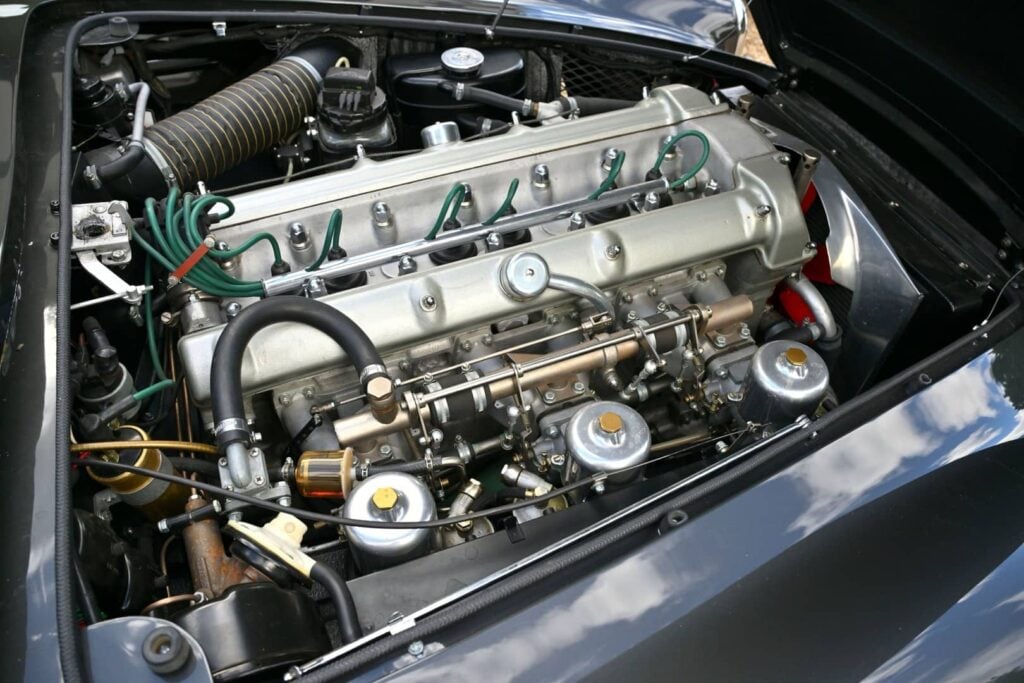
A new 3.7L double-overhead-camshaft straight-six powered the DB4. Engineer Tadek Marek designed the all-alloy unit.
Output was 240 bhp. Top speed reached around 140 mph, with 0-60 mph in about 8.5 seconds.
The DB4 also introduced several firsts for Aston Martin production cars:
- Four-wheel disc brakes
- Rack-and-pinion steering
- Fully independent front suspension
DB4 Production Series and Variants
Aston Martin built 1,110 DB4s between 1958 and 1963 across five series. Each series added incremental refinements:
- Series II: framed side windows
- Series III: revised taillights, left-hand-drive availability
- Series IV: barred grille
- Series V: longer body, raised roofline
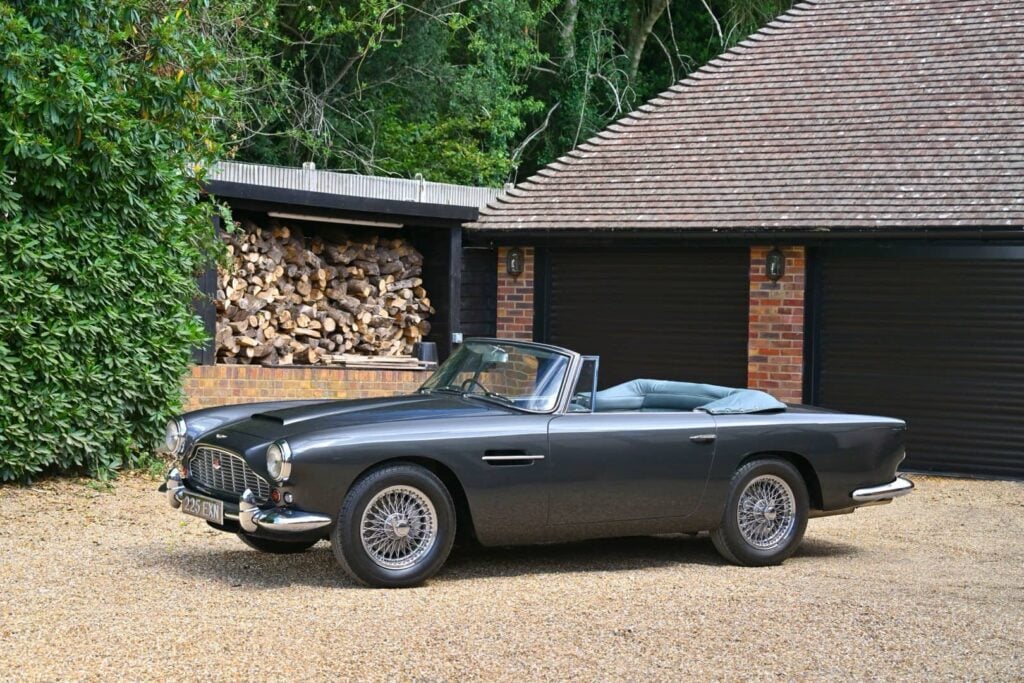
A convertible variant joined the coupe lineup in late 1961. Two high-performance derivatives followed: the race-oriented DB4 GT (75 built) and the ultra-rare DB4 GT Zagato (19 built).
The Vantage engine option arrived in 1962, raising output to roughly 266 bhp. This uprated engine carried directly into the DB4’s successor, the DB5. The DB4’s chassis and mechanical layout became the direct basis for the DB5, cementing its place in Aston Martin history.
Aston Martin DB4 Vantage Convertible: Rarity and Collector Appeal
The DB4 Vantage Convertible ranks among the rarest and most desirable DB4 variants. It combines open-top motoring with the model’s most powerful factory engine specification.
How Rare Is the DB4 Vantage Convertible?
Aston Martin built only 70 DB4 convertibles in total (1961-1963). Of those, just 32 received the Vantage engine – 11 Series IV cars and 21 Series V cars.
This makes the Vantage Convertible rarer than the fixed-head DB4 Vantage saloon, of which 136 were built. The Vantage engine added a third SU carburetor and reworked cylinder heads, lifting output to around 266 hp. Many cars also feature faired-in headlights borrowed from the DB4 GT.
Why the DB4 Vantage Convertible Holds Long-Term Value
Rarity alone doesn’t explain the model’s strong collector standing. The DB4 also holds a foundational place in Aston Martin history, having established the Newport Pagnell-built, Touring Superleggera design language that carried into the DB5.
Aston Martin DB4 Price Guide: 5-Year Value Trends
DB4 price and DB4 value figures have swung widely over the past five years (2021-2026), driven by condition, specification, and provenance rather than a single market-wide trend.
DB4 Vantage Convertible Price Range
Recorded public sales span from roughly £125,453 for a project-grade car to a record £1,513,500. The median recorded sale price sits around £611,900.
- Total DB4 convertibles built (1961-1963) – 70
- DB4 Vantage convertibles built – 32 (11 Series IV, 21 Series V)
- Lowest recorded Vantage Convertible sale – £125,453
- Median recorded Vantage Convertible sale (DB4 value benchmark) – £611,900
- Highest recorded Vantage Convertible sale – £1,513,500 (Bonhams)
- 1963 SS-engine Series V Convertible estimate (2023) – $1.5M-$1.95M
- Standard DB4 “good condition” value (Hagerty, 2025-2026) – approx. $333,000, -15.5% YoY
DB4 Value by Condition and Variant
A 1963 DB4 Series V Convertible with the ultra-rare “SS” high-compression engine carried a pre-sale estimate as high as $1.95 million in October 2023. Standard (non-Vantage) DB4 convertibles have averaged around £765,984, with top sales exceeding £1,121,000.
Hagerty’s price guide tracks the standard DB4 at roughly $333,000 in good condition, down about 15.5% year over year, while top examples reach closer to $1.48 million. Dealer asking prices across the DB4 range have stayed “broadly stable to gently rising” from 2021 into 2026.
Standard DB4 coupes trade between roughly £340,000 and £500,000. Special variants like the Vantage and GT sit well above that tier.
What Drives DB4 Vantage Convertible Auction Results
At the top end, a 1962 DB4 Vantage Convertible sold for £1,513,500 through Bonhams’ Aston Martin Works sale – the highest publicly recorded Vantage Convertible price. Lesser-specification or higher-mileage examples have sold for £430,000 to £970,000.
This spread shows condition, documented history, and matching-numbers originality drive DB4 value more than any macro trend. An 87% sell-through rate for Vantage Convertibles at auction also signals healthy buyer demand.
DB4 price performance hasn’t moved in a straight line. Values have tracked broader classic-car market sentiment, interest rates, and the appearance of exceptional or celebrity-owned cars at major sales.
Key Value Drivers: Provenance and Originality
Several specific factors move DB4 Vantage Convertible price beyond basic rarity.
Matching Numbers and Engine Specification
Matching-numbers authenticity is a top priority for buyers. High-compression “SS” engine upgrades can add substantially to estimates.
Ownership History and Celebrity Provenance
Celebrity ownership boosts DB4 value significantly. One DB4 Convertible once owned by actor Peter Sellers – fitted with a telephone and custom sound system – is a well-known example.
Factory-Backed Sales Channels
Cars sold through Aston Martin Works’ own heritage sales in Newport Pagnell tend to achieve stronger results, thanks to factory-backed documentation.
Right-Hand Drive vs. Left-Hand Drive: Value Impact
Steering-side configuration affects DB4 value in more nuanced ways than for many other collector cars, and the premium direction has shifted over time.
The Case for Left-Hand-Drive Premium
Classic Aston Martins in LHD configuration are typically rarer overall. They can command at least a 20% premium over comparable right-hand-drive examples, largely due to broader appeal across North American and European buyer pools.
Of the 45 Vantage SS examples built, only 31 were right-hand drive. LHD variants are frequently marketed as the rarer, more globally desirable configuration. RM Sotheby’s has explicitly marketed a rare LHD Vantage Convertible as “an exceedingly rare example in left-hand drive Vantage form”.
The Case for Right-Hand-Drive Value
UK-based specialists note the RHD/LHD dynamic isn’t uniform. Right-hand-drive cars have historically sold more easily within the UK domestic market.
That historical RHD premium has narrowed considerably in recent years. Investment-focused buyers increasingly value factory-original specification over steering position. Insurance costs are unaffected by steering side, removing one ownership-cost variable.
Practical Takeaways for RHD DB4 Vantage Convertibles
- A factory-original RHD car retains full authenticity for UK or Commonwealth buyers and avoids import/registration complications
- LHD DB4 Vantage models attract a global buyer pool and sometimes command a rarity premium at international auctions
- Converting a car’s original steering configuration generally hurts value, regardless of direction
- Condition, matching-numbers status, and documented history outweigh steering side alone in setting final price
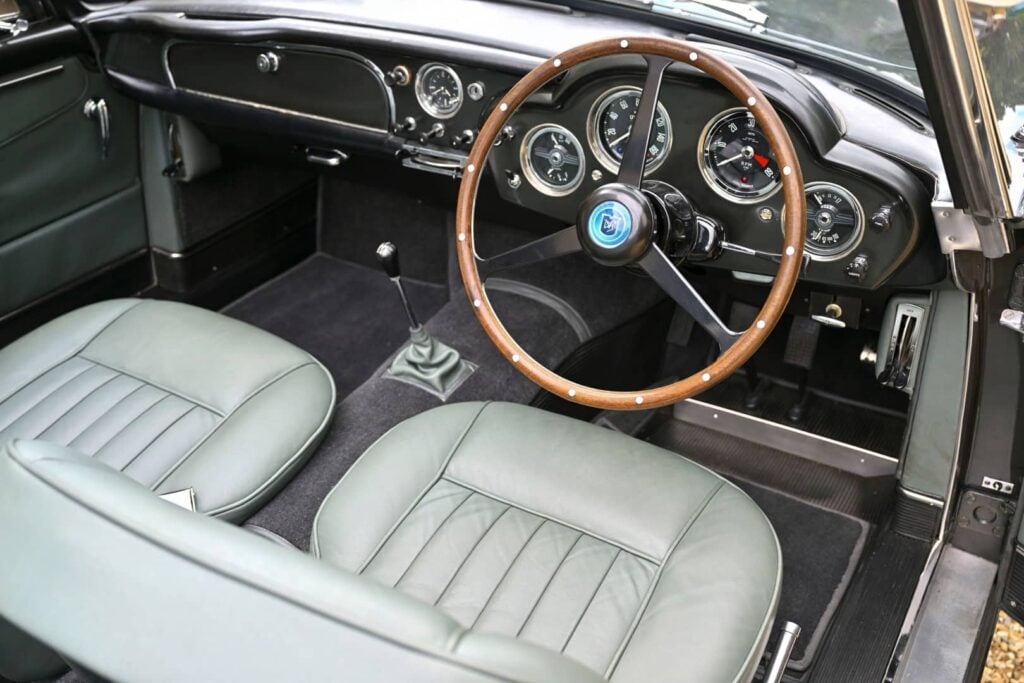
A genuine right-hand-drive DB4 Vantage Convertible isn’t inherently penalized in value, especially in the UK market where it originated. Buyers chasing maximum global marketability may still lean toward left-hand-drive examples given their scarcity.
Case Study: 1962 DB4 Vantage Convertible at Goodwood Revival
A current market example highlights how DB4 price estimates get set. Bonhams|Cars is offering a 1962 Aston Martin DB4 Vantage Convertible at the Goodwood Revival sale, September 18-19, 2026.
Sale Details and Estimate
Bonhams has set a pre-sale estimate of £700,000-£900,000 (US$950,000-US$1,200,000). The car is marketed on the strength of having had only two owners from new – a rare, highly marketable ownership history.
This Vantage Convertible stands out as the leading lot of Bonhams’ Goodwood Revival catalogue, alongside a Bugatti Type 35C Grand Prix car estimated at £500,000-£700,000.
Is the Bonhams Estimate Reasonable?
The £700,000-£900,000 range looks reasonable to conservative. It sits above the model’s historical median (£611,900) – roughly 14% above the midpoint – while stopping short of the top of documented outcomes.
This positioning fits the car’s two-owner history. Well-documented ownership chains are one of the strongest DB4 value drivers. A Vantage Convertible in single-family ownership since 1984 achieved the model’s all-time record, £1,513,500 – more than double the low end of this estimate.
That record sale also benefited from notable prior ownership and exceptional presentation, factors not confirmed for the Goodwood Revival car. This suggests £900,000 is a prudent ceiling, not an aggressive one.
Comparable DB4 Vantage Convertible Sales
Other results reinforce the estimate’s credibility:
- A Vantage Convertible from a deceased estate sold for £611,900 against a lower £360,000 estimate, showing upside potential when bidding is competitive
- A Vantage Convertible with a higher US$1.1M-$1.4M estimate reportedly failed to sell, showing overpriced estimates can misfire even for rare cars
Bonhams’ £700,000-£900,000 range reflects solid, verifiable provenance without assuming the exceptional credentials behind the very top DB4 Vantage Convertible prices above £1.2 million.