
The BMW 507 Roadster: A Commercial Failure Worth $2 Million Today
Few collector cars tell a more dramatic story than the BMW 507 Roadster. Unveiled at the Frankfurt IAA in September 1955, the 507 was designed to conquer the American sports car market – targeted at $5,000 and projected to sell 5,000 units per year. Spiraling development costs pushed the U.S. sticker price to $10,500 by 1959, and the 507 nearly drove BMW into bankruptcy before production ended in December of that year.
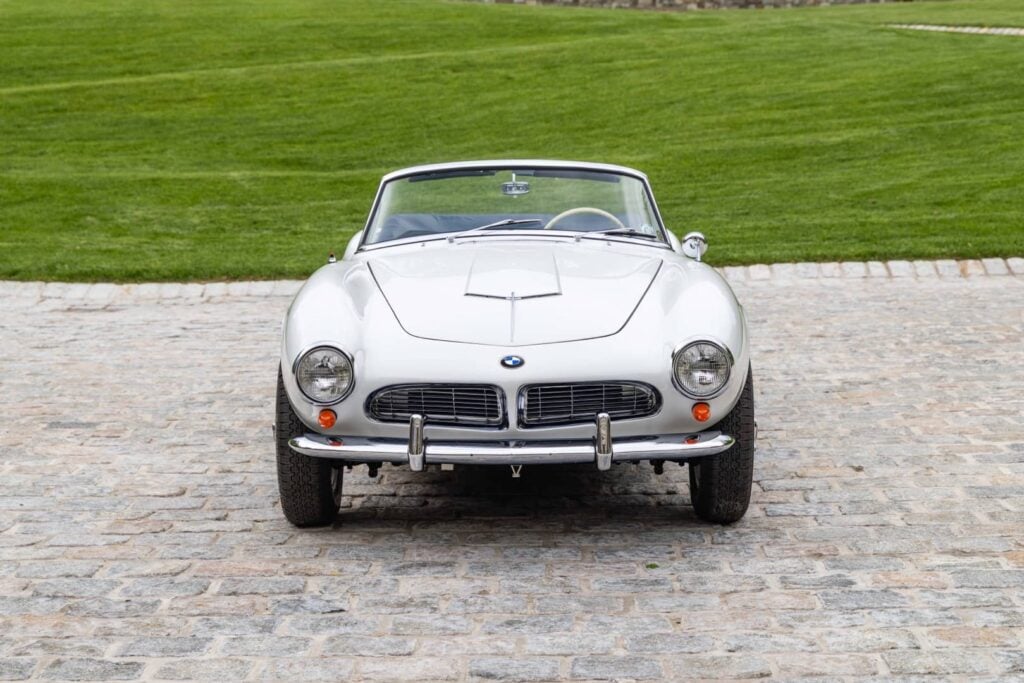
Only 252 BMW 507 Roadsters were ever built. Of those, just 202 are known to survive today. Later this year, at The Monterey Auction, RM Sotheby’s will offer one of those surviving examples for sale. That extreme scarcity has made the 507 one of the most valuable postwar European sports cars in the world. The average BMW 507 auction value now sits at approximately $1.97 million, with the all-time record – $5 million for the ex-Formula 1 World Champion John Surtees 1957 example – standing as the highest price ever paid for any BMW at auction.
The car’s mythology extends beyond performance and design. Elvis Presley acquired a 507 in December 1958 while stationed in Germany with the U.S. Army. After he shipped home without it, the car passed through several hands before BMW Classic tracked it down in a California warehouse and completed a full factory restoration – producing one of the most storied BMW 507 Roadsters in existence.
BMW 507 Series I vs. Series II: Key Differences Explained
BMW produced only 34 Series I cars between 1956 and mid-1957 before making significant revisions. Understanding those changes is essential for any prospective buyer evaluating BMW 507 Series II value against an early car.
The defining flaw of the Series I was its fuel tank – a massive 110L unit mounted behind the rear seats. It consumed cabin space and vented fumes into the cockpit whenever the roof was raised. BMW’s solution for the Series II was to relocate the tank beneath the boot floor and reduce its capacity to 66 liters, dramatically improving interior space and liveability.
Additional Series II improvements included:
- Engine output raised from ~140 bhp to 150 bhp at 5,000 rpm via higher compression ratio, revised camshaft, and updated ignition timing
- Reworked dashboard and cleaner soft-top stowage mechanism
- Optional front disc brakes on 1959 production cars, replacing the original Alfin drums
The result was a 507 that could actually be driven and shown without compromise – the definitive version of Albrecht von Goertz’s landmark design.
BMW 507 Series II Price vs. Series I: What the Market Pays
With only 34 examples produced, the Series I is roughly six times rarer than the Series II – yet the Series II consistently commands stronger prices at auction. The reason is straightforward: collectors prize usability and drivability alongside rarity, and the Series II delivers both.
Recent BMW 507 Series II price results at major auction houses confirm robust demand:
- 1958 Series II: $2,420,000 at auction
- 1957 Series II: $2,200,000-$2,750,000 estimate at Gooding & Christie’s
- 1959 Series II: €1,800,000 on Bring a Trailer, early 2025
- 1958 Series II: €1,750,000-€2,000,000 estimate at RM Sotheby’s Paris 2025
A well-documented Series I example at RM Sotheby’s Villa d’Este 2011 realized €728,000 – a figure that, even with appreciation, illustrates how substantially the Series II outperforms its rarer sibling. The Series I appeals primarily to completist collectors and marque historians; the Series II is the car the open market wants.
Comparable Classic Cars in the $1.5-$2.5 Million Price Range
The BMW 507 Series II competes with a small group of postwar European sports cars for buyers operating in the $1.5-$2.5 million bracket.
Mercedes-Benz 300 SL Roadster (W198) is the most direct rival. With ~1,858 units built, it is far more common than the 507 but commands a similar average price of approximately $1.69 million, with top examples exceeding $2 million. The 300 SL offers a larger global service network and broader name recognition – but cannot match the 507’s scarcity.
Porsche 356 Speedster competes on character rather than price, with Pre-A examples reaching $400,000-$550,000. It offers superior parts availability and usability, but occupies a lower financial tier and rarely targets the same buyer as a 507.
Ferrari 250 GT SWB Berlinetta sits above the 507, trading in the $4-$8 million range. The 507 occupies a compelling position just below Ferrari 250 territory – comparable rarity, Italian-adjacent design sensibility (von Goertz trained at Raymond Loewy’s New York studio), and postwar drama at a fraction of the price.
Classic Car | Est. Production | Avg. Auction Price | Key Trade-off vs. BMW 507 |
|---|---|---|---|
BMW 507 Series II | 218 units | ~$1.97M | – |
Mercedes 300 SL Roadster | ~1,858 units | ~$1.69M | More supply, less scarce |
Porsche 356 Speedster (Pre-A) | Limited | $400K-$550K | More usable, lower ceiling |
Ferrari 250 GT SWB | ~165 units | $8M+ | Greater pedigree, higher price |
BMW 507 Market Outlook: Price Trends and Predictions
The BMW 507 collector car market has been one of the strongest long-term appreciation stories in the classic car world. Values that stood at $300,000-$400,000 in the early 2000s crossed seven figures by the early 2010s and now average nearly $2 million – a roughly five-fold gain over two decades. Between 2020 and 2022 alone, 11 examples averaged $2.08 million at auction.
The broader collector car market softened post-pandemic. The Black Book Q1 2026 Collectible Cars Market Update noted that European sports cars declined approximately 4.95% year-over-year through 2025, with buyers increasingly focused on condition and provenance over broad market momentum. The 507 has largely held its ground: the transaction floor remains above $1.5 million, and a 60-year single-ownership Series II carried a Bonhams estimate of $1.8-$2.5 million as recently as August 2025.
Three structural factors support continued BMW 507 price strength going forward:
- Supply will never increase. With only ~202 surviving cars – the majority in permanent collections – fewer than five examples typically reach public auction in any given year.
- BMW Classic institutional support. BMW actively promotes the 507’s heritage, restores significant examples, and exhibits the model globally, sustaining collector appetite at the highest levels.
- Blue-chip investor demand. RM Sotheby’s Miami 2026 confirmed continued strength for rare, well-documented classics as serious investors favor vehicles combining exclusivity, craftsmanship, and proven long-term desirability.
The most realistic near-term trajectory for the BMW 507 Series II is range-bound appreciation between $1.8 million and $2.8 million for clean, well-documented examples – with provenance standouts (single-owner cars, factory-optioned cars, celebrity-associated examples) capable of reaching $3-$4 million when the right bidders are in the room. As one BMW Classic Car Club president has simply observed: “They are being bought as a ‘safe’ investment. Supply is limited.” That supply will never grow. Given the 507’s design legacy, institutional support, and irreplaceable place in automotive history, the demand – over time – almost certainly will.