
BMW 850 CSi Collector Car Market Analysis: 2016–2029
The BMW 850 CSi has completed its transition from depreciated 1990s flagship to established blue-chip modern classic, but its market is no longer moving in a straight line. Over the past decade, ordinary usable examples have broadly advanced from the $50,000–$75,000 territory to a roughly $90,000–$140,000 band, while unusually low-mileage, rare-color or provenance-rich cars have occasionally brought $175,000 to $266,000.
The important distinction is between the model’s rising long-term stature and the prices of individual cars. The 850 CSi market is thin, condition-sensitive and increasingly selective: mileage, originality, specification, color, documentation, maintenance and geographic location can produce six-figure differences. There has been an average sale price of $110,446 and a high of $266,000, with a low sale of $44,000.
That makes the most likely three-year outlook one of measured appreciation rather than another explosive repricing. The best cars should continue to pull away, but the center of the market is more likely to climb gradually – with periodic volatility – than to repeat the abrupt gains seen around 2020–2023.
Why the E31 CSi Matters
BMW presented the 850 CSi in 1992 as the Motorsport-developed performance flagship of the E31 range. Its 5,576 cc S70 V12 produced 280 kW, or 380 PS in European specification, and was paired exclusively with a six-speed manual gearbox; BMW also gave the model larger brakes, a more sporting chassis tune and distinct exterior details.
Rarity gives the car an unusually clean collector narrative. BMW states that 1,510 examples were built from 1992 to 1996, including 225 U.S.-specification cars and 160 right-hand-drive examples. The WBS VIN prefix further identifies the 850 CSi as a BMW Motorsport product, reinforcing its status as the production-era answer to the E31 M8 that never reached showrooms.
That combination – naturally aspirated V12, manual transmission, limited production, Motorsport engineering and unmistakably 1990s styling – is becoming harder to replicate in the modern market. It also places the 850 CSi at the intersection of several durable collecting themes: analog performance cars, 1990s “youngtimers,” flagship German coupes and unofficial or under-the-radar M cars.
Ten Years of Results
The decade’s auction record is best read as a series of repricing phases rather than a smooth index. These representative results mix online auctions and traditional houses, so they should not be treated as like-for-like transactions; nevertheless, they show how the market’s ceiling and floor have moved.
Three phases emerge over the past decade. From 2016 through 2019, buyers began separating the CSi from ordinary E31s, with good cars moving from the mid-$50,000s into six figures and ultra-low-mileage examples already commanding far more. From 2020 through 2023, online-auction visibility, youngtimer enthusiasm and scarce supply accelerated the move, culminating in the $266,000 BaT sale and the $218,400 chassis-number-one result at RM Sotheby’s.
Since 2024, the market has become more discriminating. Results from $88,850 to $131,000 are common enough to establish a real trading band, while the $250,000 BaT sale proves that near-record money remains available for a 14,000-mile car. Conversely, a 52,000-mile U.S. car failed to meet reserve at $105,000 in January 2025, and a 31,000-mile example stalled at $142,500 in July 2026, evidence that sellers cannot assume every CSi deserves top-tier pricing.
The Audrain Benchmark
The 1995 BMW 850 CSi sold for $100,800 at Broad Arrow’s Audrain Auction in Newport, Rhode Island, on October 2, 2026. The 59,000-mile U.S.-specification car, chassis WBSEG9323SCD00180, was offered without reserve against a $100,000–$125,000 estimate and sold just above the low estimate.
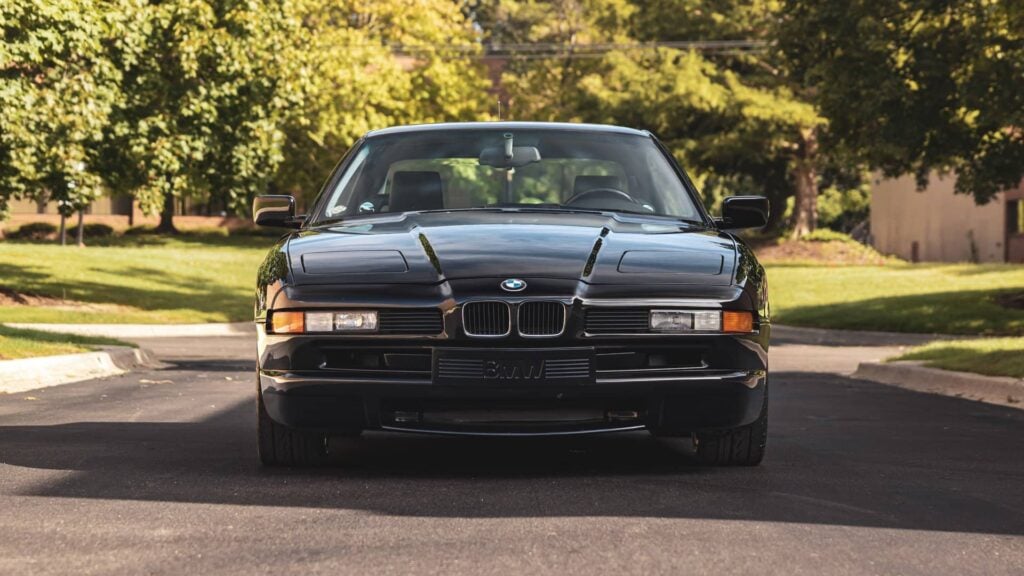
This result is more informative than a headline-grabbing record because it reflects the type of CSi most buyers are likely to encounter: a usable, higher-mileage U.S. car in Jet Black over black rather than an ultra-low-mile preservation example or one-off BMW Individual color. Its $100,800 price therefore supports a current center of gravity near $100,000 for honest, non-exceptional cars – not a universal $150,000-plus valuation.
The same chassis was reported as a no-sale at an $81,500 high bid in July 2020, when it showed 56,000 miles. Comparing a failed bid with a later completed sale is not a formal appreciation calculation, but the 23.7 percent nominal difference over six years underscores how much of the broad repricing may already have occurred. It also suggests that transaction quality, reserve strategy and venue matter nearly as much as calendar-year market movement.
The Zoute Test
Broad Arrow will offer a 1993 BMW 850 CSi without reserve at its Zoute Concours Auction in Belgium on October 9, 2026, with a pre-auction estimate of €125,000–€150,000. Chassis WBSEG91000CC00519 shows just under 63,000 km and combines special-order Violet Blue metallic paint with matching Violet Blue leather. It is reported to be one of only four examples of the 850 CSi finished in that exterior color.
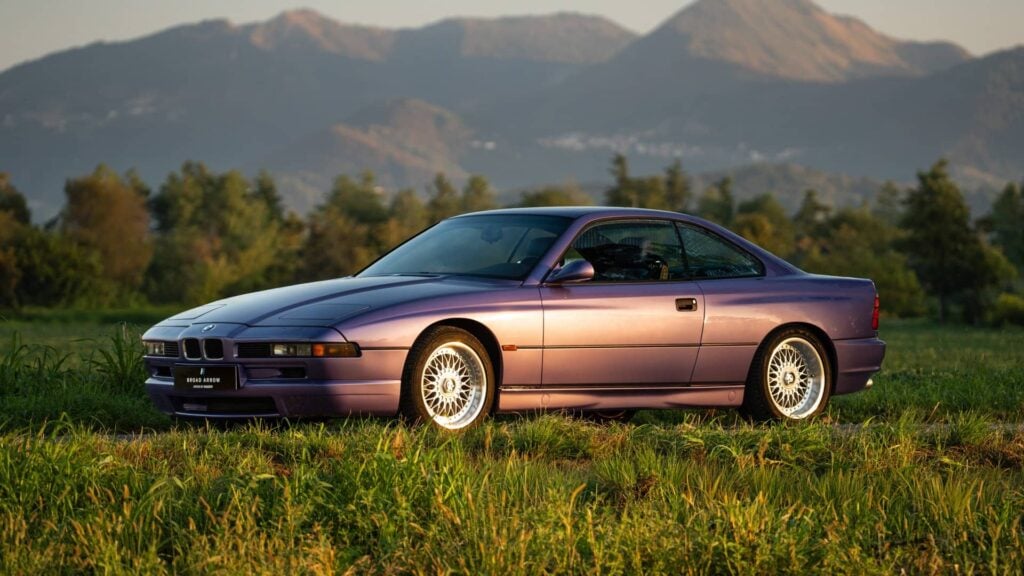
Its equipment includes an electric sunroof, heated memory seats, fine wood trim, BMW Business CD audio with a six-disc changer and the HiFi speaker system, while its documented pre-delivery inspection took place in Kronberg, Germany, on June 21, 1993. The configuration makes it materially more collectible than an average European-market car, so the result should not be applied indiscriminately to the whole model line.
Even so, the no-reserve sale could become an important price-discovery event:
- At or above €150,000: This would show that European bidders will pay near top-tier money for special specification and moderate mileage, supporting upward revisions for the best non-delivery-mile cars.
- Between €125,000 and €150,000: This would validate Broad Arrow’s estimate and confirm that rare colors and strong presentation can move a 63,000-km car well beyond the ordinary €90,000–€110,000 bracket.
- Between €105,000 and €125,000: This would still be a credible result, but it would suggest the estimate was aspirational and that buyers remain disciplined.
- Below €105,000: This would be a cautionary signal for the European market, especially because the car’s color, mileage and no-reserve format leave few excuses for a weak result.
For context, a 1993 car with 61,930 km sold for €69,300 through RM Sotheby’s in 2025, while Broad Arrow sold another 1993 example for €92,000 at Villa d’Este in 2026. A Zoute result within the estimate would therefore represent a meaningful premium for rarity of specification, not merely a routine continuation of the market.
What Drives 850 CSi Value
The CSi’s price hierarchy becomes clearer as the auction record expands.
- Mileage and originality: The $250,000, 14,000-mile BaT result and £184,000, 3,600-km RM Sotheby’s sale demonstrate the premium for preservation-grade examples.
- Color and specification: Hellrot, Dakar Yellow, Lagoon Green, Tobago Blue and Violet Blue cars attract attention, but rarity does not automatically overcome mileage, modifications or condition.
- U.S. versus European specification: The 225-car U.S. production figure creates an especially simple scarcity story for American buyers, while European cars can add desirable equipment such as active rear-axle steering and broader Individual specifications.
- History and identity: Chassis 00001 at $218,400 shows the premium available for a car whose identity is historically significant, even when an ordinary example from the same model year would bring much less.
- Deferred maintenance: The S70 V12, dual electronic systems and E31-specific components reward documented specialist care. Buyers increasingly discount cars whose lower purchase price could be erased by recommissioning.
- Venue and presentation: Detailed photography, cold-start and driving videos, service invoices and informed comment threads can materially improve confidence in a complex 1990s flagship. Conversely, reserve-not-met results reveal that asking expectations remain ahead of executable bids on some cars.
Three-Year Outlook
Through the end of 2029, the base case is for nominal values of sound 850 CSis to rise by roughly 3–7 percent annually, with substantial variation around that trend. That would amount to approximately 9–23 percent cumulative appreciation over three years, but it should be viewed as a scenario rather than a guarantee.
The bullish case rests on demographics and specification. Buyers who grew up with the E31 are entering peak collecting years, while the market has increasingly rewarded naturally aspirated engines, manual gearboxes and era-defining design. The supply is permanently limited, and BMW itself openly places the CSi within the M lineage despite the absence of an M8 badge.
The moderating factors are equally real. The 2023 record has not reset every car to $200,000. 2025–2026 results still include no-reserve sales around $89,000–$101,000, and no sales as high as $142,500. Maintenance exposure, thin liquidity, currency movements and differences between U.S. and European bidders can also create abrupt price gaps.
The most likely outcome is therefore a widening spread rather than a uniform rise. Exceptional, original, low-mileage cars in rare factory colors should set the pace, while average cars appreciate more slowly and neglected examples may stagnate. A strong Zoute result would raise the near-term ceiling for special European cars; a weak one would confirm that the market’s enthusiasm remains concentrated at the very top.
Buying and Selling Implications
For a buyer, the strongest value proposition is probably not the cheapest available 850 CSi, but a fully documented, largely original car with consistent ownership history, correct factory specification and recent specialist servicing. Paying a premium for evidence of proper care is rational when a major mechanical or electronic recommissioning could consume much of the difference between a driver-grade and a better example.
For a seller, originality and documentation should be made legible. Factory build information, service records, paint-meter readings, underbody photography, operational demonstrations of the electrical systems and a specialist inspection can distinguish a six-figure collector car from a risky old V12 coupe.
The Audrain result supplies the clearest current benchmark for the middle of the U.S. market: $100,800 for a 59,000-mile car. The forthcoming Violet Blue car at Zoute will test the upper-middle European tier. Together, the two sales frame the 850 CSi market in late 2026: approximately $100,000 for a usable, standard-color example, with a possible 25–50 percent premium for a rarer, lower-mileage and more distinctive specification.
The BMW 850 CSi’s long-term collector credentials look secure. Over the next three years, however, returns are likely to come from buying quality and rarity intelligently – not merely from owning any car with an 850 CSi badge.