
Recalibrating a Legend: The Ferrari 250 GT California Spider's Value Over Three Years
Few collector cars carry the mystique of the Ferrari 250 GT California Spider. Between 1957 and 1963, Ferrari built just 106 examples across two series – 50 long-wheelbase (LWB) cars and 56 short-wheelbase (SWB) cars – each hand-formed in aluminum and steel by Sergio Scaglietti in Modena. Both variants rank among the most valuable road-going Ferraris ever produced. Yet the past three years have told a nuanced story of market correction, widening price gaps between the two wheelbases, and a collector base that increasingly rewards the exceptional while punishing the merely rare.
Two Wheelbases, Two Markets
Understanding the value trajectory of the California Spider requires first understanding why the LWB and SWB command such different prices. The LWB, produced from 1957 to 1960, rides on a 2,600 mm wheelbase derived from the 250 GT Tour de France Berlinetta. It produces approximately 240 horsepower from the Colombo V12 in standard road tune and was initially equipped with drum brakes. Its proportions are long, elegant, and unmistakably late-1950s – a car conceived for Hollywood boulevards and the California coast at the urging of American importer Luigi Chinetti and West Coast distributor John von Neumann.
The SWB, introduced in 1960, adopted a shorter 2,400 mm wheelbase from the 250 GT SWB Berlinetta, bringing wider front and rear track, standard four-wheel Dunlop disc brakes, and an upgraded outside-plug Tipo 168 Colombo V12 producing 280 horsepower – a full 40 horsepower advantage over the LWB. DK Engineering’s James Cottingham has described the difference succinctly: “the LWB has the roomier cockpit which is useful for a tall driver, but undoubtedly the SWB has a more dynamic and compliant feeling, is a more capable car, and has superior handling”. The SWB also boasts a stronger competition pedigree, with examples raced at Le Mans, Sebring, and the Targa Florio.
That mechanical and historical superiority translates directly into price. Through early 2026, the median auction price for an LWB California Spider since 2020 is roughly $5.5 million, while the SWB commands a median of about $16.8 million – a ratio of approximately 3:1 in the SWB’s favor. Only 37 of the 56 SWBs were built in the more sought-after covered-headlight configuration, further compressing supply at the top of that market.

A Strong Opening: 2023
The California Spider entered 2023 with prices that still echoed the confidence of the post-pandemic surge. At Gooding & Company’s Amelia Island sale in March 2023, a 1962 SWB California Spider sold for $18,045,000 – the highest result of the entire Amelia Island auction week. That figure placed the covered-headlight SWB firmly in rarefied territory and anchored market expectations for the broader model family.
On the LWB side, an example was offered at RM Sotheby’s Amelia Island sale that same month but failed to sell. The divergence was already visible: the SWB attracted aggressive bidding while the LWB struggled to meet its reserve.
Hagerty’s Blue Chip Index, which tracks 25 of the most sought-after collector cars, had entered a period of softening during 2023. Yet the top-tier SWB results suggested that the California Spider family might be insulated. That assumption would soon be tested.
Correction Arrives: 2024
The adjustment came in earnest in 2024. Hagerty reported that the Ferrari Index declined 4 percent in the first quarter, the first negative move since May 2020, with both the LWB and SWB California Spiders retreating 6 percent. Hagerty’s analysts noted that “vintage Ferrari buyers are increasingly selective,” rewarding exceptional provenance while being cautious with less documented examples.
The LWB bore the brunt of the correction. In February 2024, a 1958 LWB California Spider was offered at Artcurial’s Rétromobile sale in Paris with an estimate of €8.5 million to €11.5 million. It failed to sell. Three months later, Artcurial offered a different 1958 LWB at its “W Collection” sale in Monaco, estimated at €7 million to €10 million. It hammered at just €4,450,000 – roughly $5.6 million including the buyer’s premium – a figure one commentator described as “the sort of money these cars were going for over 10 years ago”.
At RM Sotheby’s flagship Monterey sale in August 2024, a 1959 LWB California Spider sold for $5,615,000. It was a clean car with 19 years of single-ownership care, yet the price represented a significant retreat from the $8 million-$9 million range that standard LWB examples had commanded a decade earlier.
The SWB fared somewhat better but was not immune. At RM Sotheby’s Monterey 2024, a 1960 SWB sold for $17,055,000 – respectable, but essentially flat compared to 2023 results. Meanwhile, a different SWB was offered at Gooding & Company’s Pebble Beach 2024 sale and did not sell. At Mecum Kissimmee in January 2024, a 1963 SWB California Spider sold for $17,875,000, demonstrating that the covered-headlight SWBs could still command strong prices if the car was right.
The broader market data confirmed the trend. The collector car market saw prices fall roughly 10.2 percent year-over-year in 2024, with 1960s classics experiencing some of the largest corrections. Italian marques declined an aggregate 8 percent, and Ferrari was not exempt.
A Bifurcated Market: 2025
If 2024 was the year of correction, 2025 revealed a market that had bifurcated sharply – not just between good and great examples, but between the two wheelbases themselves.
The defining LWB result came at Broad Arrow’s Amelia Island auction in March 2025. A legendary 1959 LWB California Spider Competizione – chassis 1451 GT, the Le Mans-raced, aluminum-bodied example – sold for $9,465,000. Impressive on its face, but the same car had sold for $17,990,000 at RM Sotheby’s New York in 2017, representing a roughly 47 percent decline in eight years. Even with competition history and an alloy body, the LWB could not escape the shifting market.
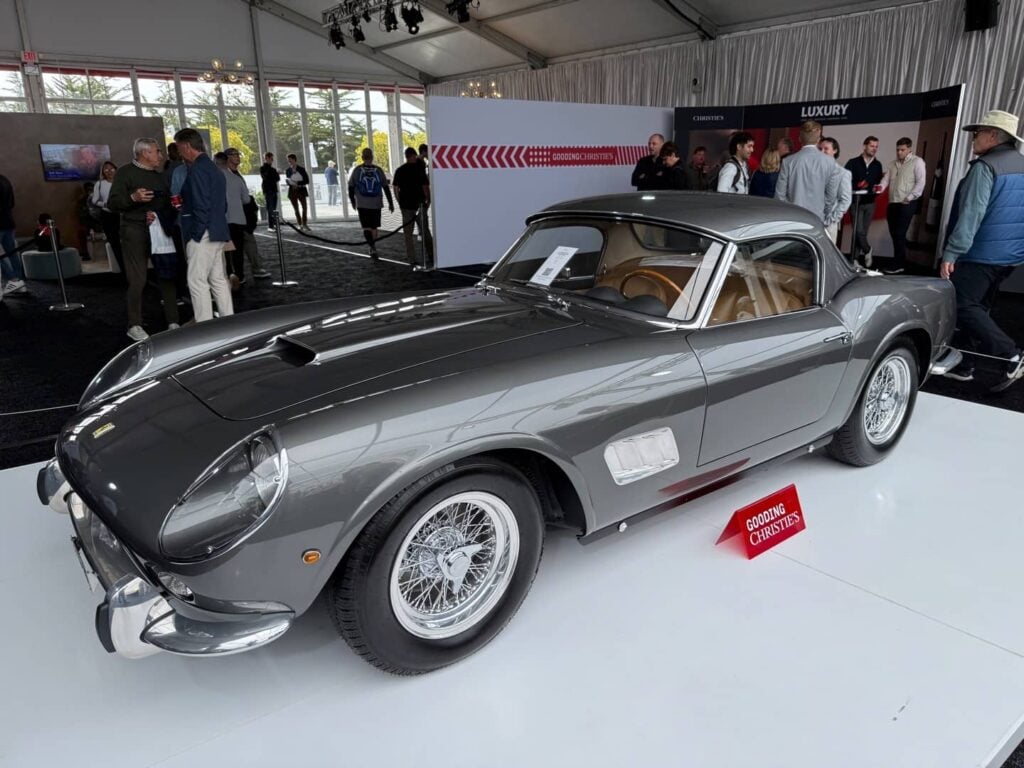
The SWB told a dramatically different story. At Gooding Christie’s Pebble Beach sale in August 2025, a 1961 SWB California Spider Competizione – one of only two alloy-bodied, full-competition examples ever built – sold for $25,305,000, setting a new auction record for the entire California Spider model line. That figure exceeded the pre-sale estimate of $20 million and established a new house record for the recently merged Gooding Christie’s. President David Gooding noted that the car’s “significance as one of only two alloy-bodied, competition SWB California Spyders cannot be emphasized enough”.
A total of three California Spiders sold at Gooding Christie’s that same Monterey week, and the results perfectly illustrated the hierarchy.
The Prototipo – the very first California Spider ever built – sold for $7,265,000, less than a standard SWB. That single data point encapsulates how drastically the market now differentiates between wheelbases. A standard SWB with no competition history commanded a small premium over the most historically significant LWB in existence.
The standard SWB’s $7,550,000 result also fell below its $8 million to $10 million estimate, underscoring that even within the SWB market, only the very best, most significant examples will exceed expectations.
Into 2026: Continued Selectivity
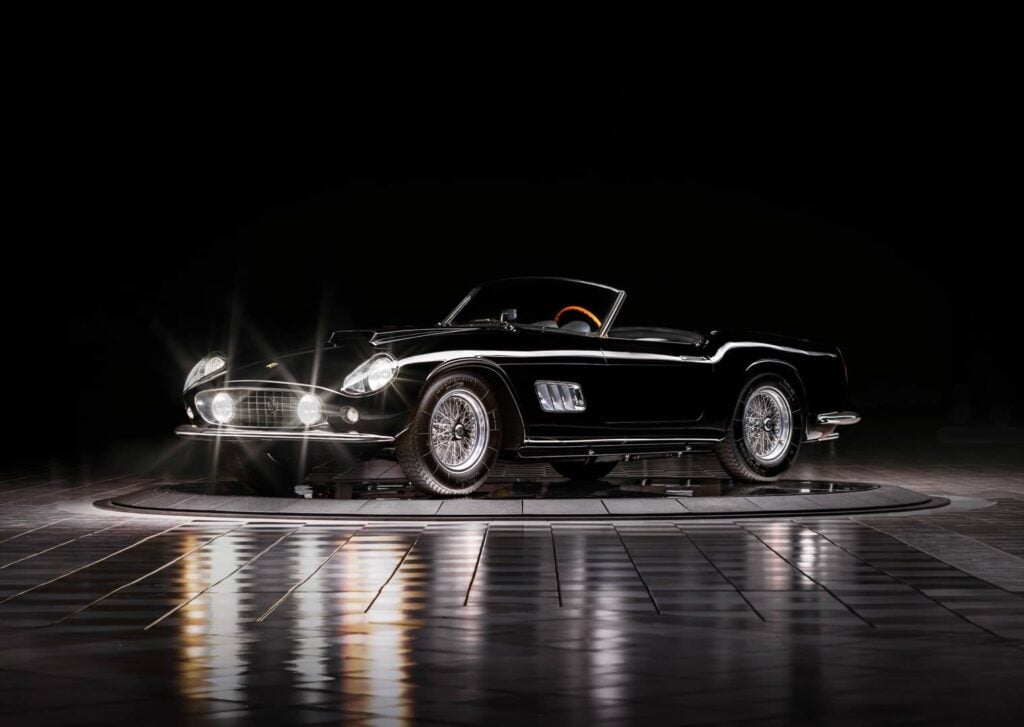
Early 2026 has reinforced the pattern. At Gooding Christie’s inaugural Paris Rétromobile sale in late January 2026, a 1958 LWB California Spider – the third LWB ever built, with covered headlights – was estimated at €5.5 million to €6.5 million. It did not sell. At the same sale, a 1960 SWB also failed to find a buyer.
However, the following day at RM Sotheby’s Paris sale, a 1960 SWB California Spider sold for €14,067,500 (roughly $15.3 million), demonstrating once again that collectors will pay full retail when the car ticks every box. The result aligned closely with the SWB’s historical median and confirmed that blue-chip SWB pricing has stabilized even as the LWB continues to search for a floor.
Meanwhile, RM Sotheby’s has consigned a 1959 LWB California Spider for its ModaMiami 2026 sale – a Pebble Beach Concours trophy winner with Cavallino Platinum awards and 19 years of continuous ownership, plus three Best of Show wins. It represents exactly the kind of provenance the market now demands from an LWB to generate competitive bidding.
The Widening Gap
The data over the past three years paints a clear picture. Standard LWB California Spiders have moved from the $8 million-$9 million range to approximately $5 million-$6 million – a decline of 30 to 35 percent from their mid-2010s peaks. The LWB sell-through rate remains a healthy 74 percent, suggesting the market is active, but at substantially lower price levels.
The SWB, by contrast, has held its value far more effectively. Its median remains around $16.8 million, and exceptional examples – particularly covered-headlight cars or those with competition provenance – can still reach $17 million to $25 million. The trade-off is liquidity: the SWB’s all-time sell-through rate is just 48 percent, meaning sellers frequently hold reserves that the market cannot meet.
The gap between the two variants has widened from roughly 2:1 in the mid-2010s to approximately 3:1 today. The technical improvements the SWB offered – disc brakes, 40 additional horsepower, tighter handling, and a more aggressive Scaglietti body – have become increasingly important to a collector base that now prioritizes driving experience alongside aesthetic beauty. The SWB’s stronger competition record, with examples campaigned at Le Mans and Sebring, provides the provenance narrative that today’s market demands.
What It Means for Buyers and Sellers
For prospective buyers, the LWB California Spider presents the most favorable entry point in over a decade. At roughly $5.5 million for a standard steel-bodied example, the car offers one of the great Scaglietti shapes at a fraction of what its SWB sibling commands. For those who value the elegance of the longer-wheelbase proportions and can live without disc brakes, the current market is a rare opportunity.
For SWB buyers, the challenge is different: finding a willing seller. The low sell-through rate suggests that many SWB owners have price expectations rooted in the 2014-2016 peak and are content to wait. When the right car does appear – covered headlights, documented history, strong color combination – competition among bidders remains fierce.
For sellers of either variant, the lesson of the past three years is that provenance has become the single most important determinant of value. Cars with competition history, concours awards, long-term ownership, or singular factory specifications continue to outperform. Cars that are merely rare – and at 50 or 56 units, every California Spider is rare – are no longer guaranteed to meet ambitious estimates.
The Ferrari 250 GT California Spider, in both LWB and SWB form, remains one of the most beautiful and desirable automobiles ever created. Its value has not collapsed – it has recalibrated. And the market has rendered its verdict: in the world of the California Spider, the short wheelbase now reigns supreme.