
The Daytona Spyder: The Ultimate Open-Top Ferrari
Few collector cars command the reverence – and the price – of the Ferrari 365 GTS/4 Daytona Spyder. With only 122 examples ever built, it sits at the very top of the vintage Ferrari hierarchy, combining V12 drama with open-air glamour that no coupe can replicate. Whether you’re tracking Daytona Spyder value as a collector or simply fascinated by Ferrari history, this is a car that demands attention.
The Ferrari Daytona: A Grand Tourer for the Ages
Ferrari unveiled the 365 GTB/4 at the 1968 Paris Motor Show. Though Enzo Ferrari famously rejected the “Daytona” nickname – it had leaked to the press before the launch – the name stuck, a tribute to Ferrari’s legendary 1-2-3 finish at the 1967 Daytona 24 Hours.
Under the long hood sat a 4.4L, quad-cam Colombo V12 breathing through six Weber carburetors, producing 352 horsepower. At the time, Road & Track called it “the best sports car in the world.” With a top speed exceeding 174 mph, nothing on the road could match it.
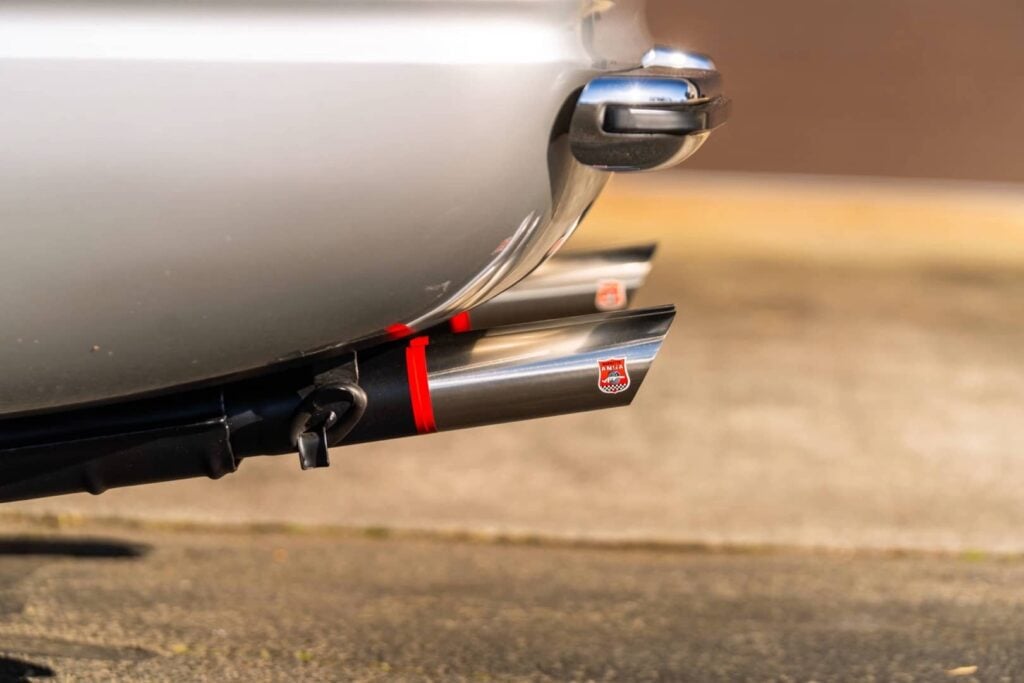
The Daytona Berlinetta (GTB/4) went on to become one of Ferrari’s best-selling grand tourers, with 1,284 coupes produced through 1973. But it was the open-top model – the 365 GTS/4 – that would become the rarest and most coveted variant of all.
The Spyder: Born from Exclusivity
Ferrari introduced the 365 GTS/4 Daytona Spyder in 1971, two years after the coupe. Pininfarina designer Leonardo Fioravanti penned the convertible bodywork, which was then hand-built by Carrozzeria Scaglietti in Modena – the same artisans responsible for the Berlinetta. The result was a car that wore the Daytona’s iconic long hood and sweeping flanks with the added drama of an open cockpit.
Production was deliberately limited. Just 122 Spyders were built over a three-year run from 1971 to 1973, compared to 1,284 Berlinettas. Of those, 96 were built to U.S. specification, while only 25 (plus one prototype) were destined for European markets. Just seven were built in right-hand drive.
When new, the Spyder carried a significant premium over the coupe. The GTB/4 Berlinetta listed for approximately $19,700, while the GTS/4 Spyder commanded around $25,000 – a premium of roughly 27% for the open-top body. Every Spyder was built to order, making each one a bespoke creation from the factory floor.
Why the Spyder Is in a Class of Its Own
The 365 GTS/4’s rarity is not just about production numbers. Collectors also prize the Daytona Spyder because of its authenticity. In the 1970s and 1980s, many coupe owners had their GTB/4s converted to Spyder specification by private coachbuilders – a practice that created a flood of replicas. These “conversion Spyders” can be visually indistinguishable from the real thing, making provenance documentation and Ferrari Classiche certification absolutely critical.
A genuine factory Spyder – verifiable through its Scaglietti body number, factory build records, and Ferrari Classiche Red Book – commands a multiple of what a conversion car will bring. This authenticity premium is a defining feature of the Daytona Spyder market today.
Daytona Spyder Value: What the Market Says
The Daytona Spyder price has traveled a remarkable arc over the decades. These cars fetched over $1 million in the early 1990s Ferrari boom, crashed to $200,000 – $300,000 in the late 1990s, and have since climbed back to multi-million-dollar territory.
Today, the market benchmark for the 365 GTS/4 sits around $2.5 – $3.5 million for a well-documented, Classiche-certified example. Recent auction results confirm this range:
- €3,436,250 (~$3.98M) – 1972 GTS/4, RM Sotheby’s Monaco, May 2024
- €3,098,750 (~$3.59M) – 1973 GTS/4, RM Sotheby’s Munich, November 2023
- $2,865,000 – 1972 GTS/4, RM Sotheby’s Monterey, August 2022
- $2,205,000 – 1972 GTS/4, RM Sotheby’s Monterey, August 2023
- $2,452,500 – 1971 GTS/4, RM Sotheby’s, May 2021
The data shows that Daytona Spyder values peaked around 2022-2024 on the strength of exceptional examples. The broader collector car market has softened modestly since then – Ferrari values are down approximately 9% year-over-year – but top-quality, Classiche-certified Spyders have shown remarkable resilience.
Spyder vs. Berlinetta: A World of Difference
The price gulf between the GTS/4 Spyder and the GTB/4 Berlinetta coupe is staggering. The average auction price for the 365 GTB/4 Daytona coupe is approximately $690,000, while the average for the Spyder is nearly $2.7 million – nearly four times as much for the open-top car.
To put it in perspective: at a 2021 Monterey auction, a yellow 1971 GTS/4 Spyder was estimated at $2.25-$2.75 million. At the same auction, a beautifully restored 1972 GTB/4 Berlinetta was estimated at just $500,000-$600,000. That’s the open-top premium in real money.
How the Daytona Spyder Stacks Up Against Its Rivals
The GTS/4 Daytona Spyder occupied a unique position in the early 1970s supercar landscape. Its chief rival for open-top exotic status was the Maserati Ghibli Spyder – produced in even smaller numbers – is comparable, with values in the $500,000-$1 million range, though it lacks the Ferrari mystique.
Among all front-engine V12 open-top grand tourers of the era, the Daytona Spyder remains the benchmark. Its combination of 352 horsepower, 174-mph capability, and Pininfarina/Scaglietti coachwork places it in a class of its own, commanding a premium that neither the Maserati nor the Aston Martin V8 Volante of the era can approach.
Daytona Spyder Auction: Two Rare Examples at Mecum Indianapolis 2026
For collectors seeking a live Daytona Spyder auction opportunity, Mecum’s 39th Annual Original Spring Classic in Indianapolis is unmissable. Running May 8-16, 2026, at the Indiana State Fairgrounds, the sale is one of the world’s largest collector car events – and this year it features not one but two factory Daytona Spyders, both offered with no reserve, as part of The M Group Collection.
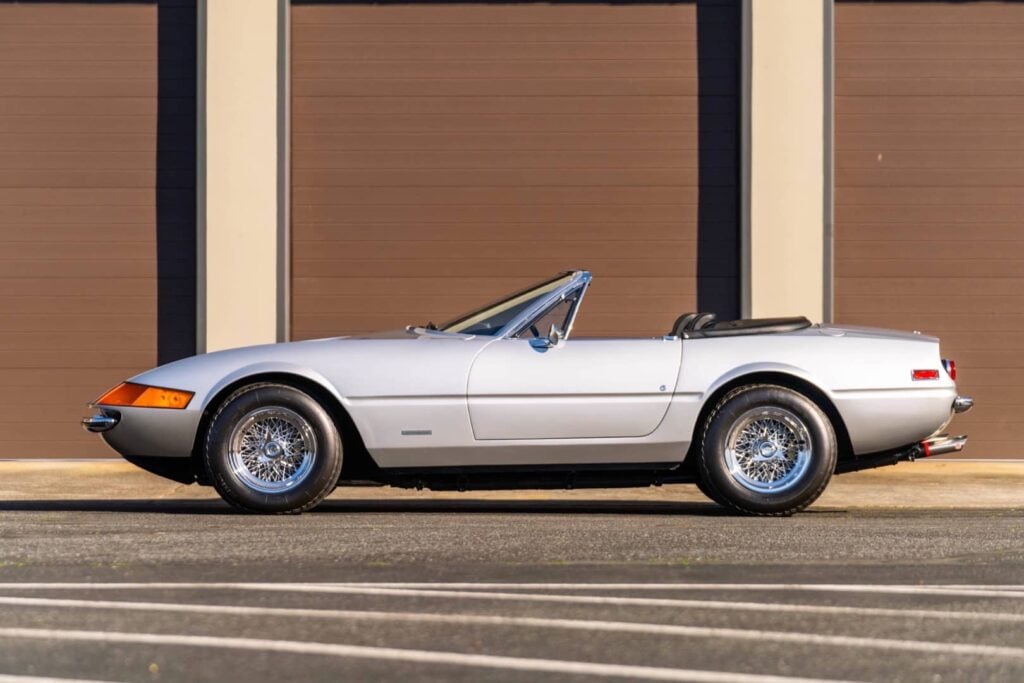
The 31st of 122 Spyders built, this 1971 example is one of only 14 produced in Argento Metallizzato – making it a rarity within a rarity. Delivered new through Luigi Chinetti Motors in June 1972 to Carl A. Haas Automobile Imports, the car’s most celebrated owner was Academy Award-winning director Sydney Pollack, who won Oscars for Best Picture and Best Director for Out of Africa (1985). Restored by Vantage Motor Works and further refreshed around 2009 by Steve Babinsky’s Automotive Restorations, it retains its matching-numbers 4.4L V12 and 5-speed transmission. It earned an FCA Platinum award at Concorso Arizona in 2007 and is offered with tools and manuals. At no reserve, this is a rare chance to acquire one of the most distinctive and provenance-rich Daytona Spyders in existence.
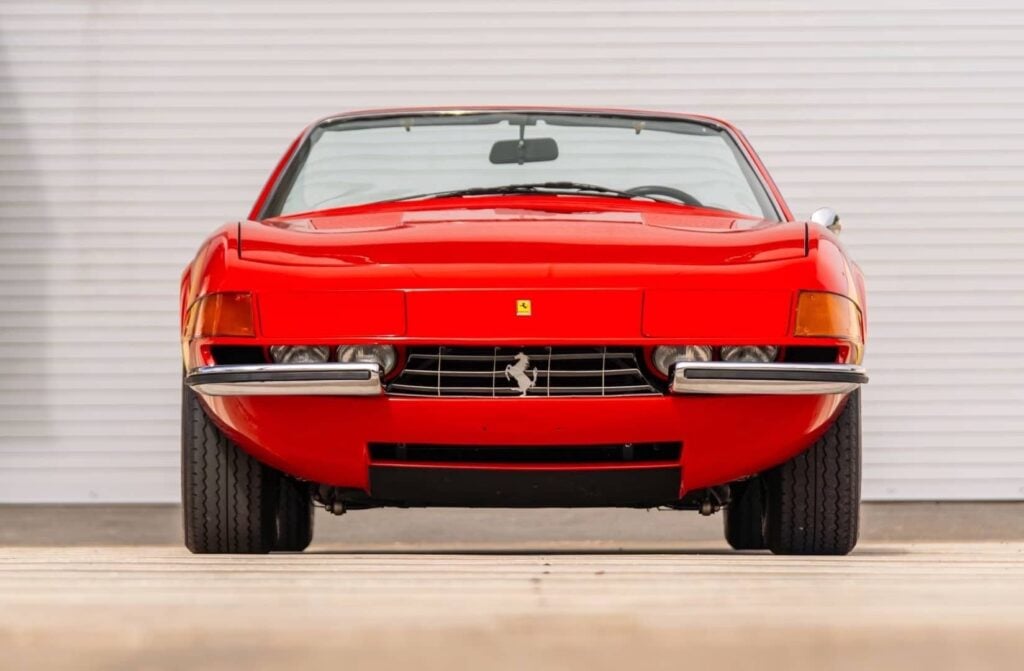
The second Mecum Daytona Spyder offering carries its own cinematic pedigree. Delivered new in April 1972 to Bill Harrah’s Modern Classic Motors in Reno, Nevada, S/N 15007 was displayed at the 1972 Los Angeles Auto Show before being acquired in October 1975 by Warner Bros. Pictures – where it is believed to have appeared in several high-profile productions. Today the car retains its original chassis, 4.4L DOHC V12, and coachwork, and is equipped with factory Borletti air conditioning and Borrani wire wheels. Critically, it is accompanied by its Ferrari Classiche Red Book and a Marcel Massini report, the gold standard of Daytona authentication. It, too, is offered at no reserve.
The simultaneous offering of two factory Spyders – both with compelling Hollywood histories – at a single auction is an exceptionally rare occurrence. With no reserve on either car, the market will speak freely on what these iconic machines are worth today.
Investing in a Daytona Spyder Today
For serious collectors, the Ferrari 365 GTS/4 Daytona Spyder price reflects both its scarcity and its symbolic importance as the last great front-engine Ferrari V12 convertible of the analog era. With only 122 examples ever made – and the supply of truly documented, matching-numbers cars finite – the Daytona Spyder is the type of car that can quickly cost more to buy than one would expect (or prefer).
The keys to Daytona Spyder value at the top of the market are consistency: matching-numbers drivetrain, Ferrari Classiche certification, documented history, and ideally a rare or original factory color specification. European-market cars (just 25 built) carry an additional premium given their lower production numbers.
In a broader collector market that has shown some softness, the Daytona Spyder remains one of the few vintage Ferraris where six-figure price differences between individual examples are the norm, not the exception. For collectors who demand the very best of the 1970s Italian supercar era, there is simply nothing quite like it.