
The Man Behind the Grand Sport Legend
The Corvette Grand Sport story begins with Zora Arkus-Duntov – the Russian-born engineer who became the soul of the Corvette. In 1953, Duntov attended the GM Motorama show in New York, saw the first Corvette, and wrote directly to chief engineer Ed Cole with ideas for improvement. Cole hired him on the spot.
By 1957, Duntov had been named director of high-performance vehicles. Under his leadership, the Corvette received its first V8 engine and became the first production car in the world to produce one horsepower per cubic inch of displacement. His ambitions, however, went far beyond the showroom floor.
Racing Roots: Le Mans 1960
In 1957, General Motors signed the Automobile Manufacturers Association (AMA) ban on factory-backed motorsports. The ban slowed Duntov – it did not stop him.
In 1960, Duntov quietly encouraged privateer Briggs Cunningham to enter three Corvettes at the 24 Hours of Le Mans. Powered by the 283 cubic-inch fuel-injected V8, the No. 3 car driven by John Fitch and Bob Grossman finished eighth overall and won the large-displacement GT class. America had proven its sports car could run with Europe’s best.
That result set the stage for one of the most daring secret programs in automotive history.

Project Lightweight: The Birth of the Grand Sport
In 1962, Duntov pitched Chevrolet general manager Bunkie Knudsen on a radical idea: build a lightweight racing Corvette to demolish Carroll Shelby’s new Cobra in FIA GT World Championship competition. The program was code-named Project Lightweight – and it was kept off the books.
The engineering was extraordinary. Duntov’s team built a rigid twin-tube steel frame clothed in paper-thin, hand-laid fiberglass panels. Aluminum and magnesium components were used throughout. The finished car weighed just 1,900 pounds – roughly 1,000 pounds less than a production Sting Ray.
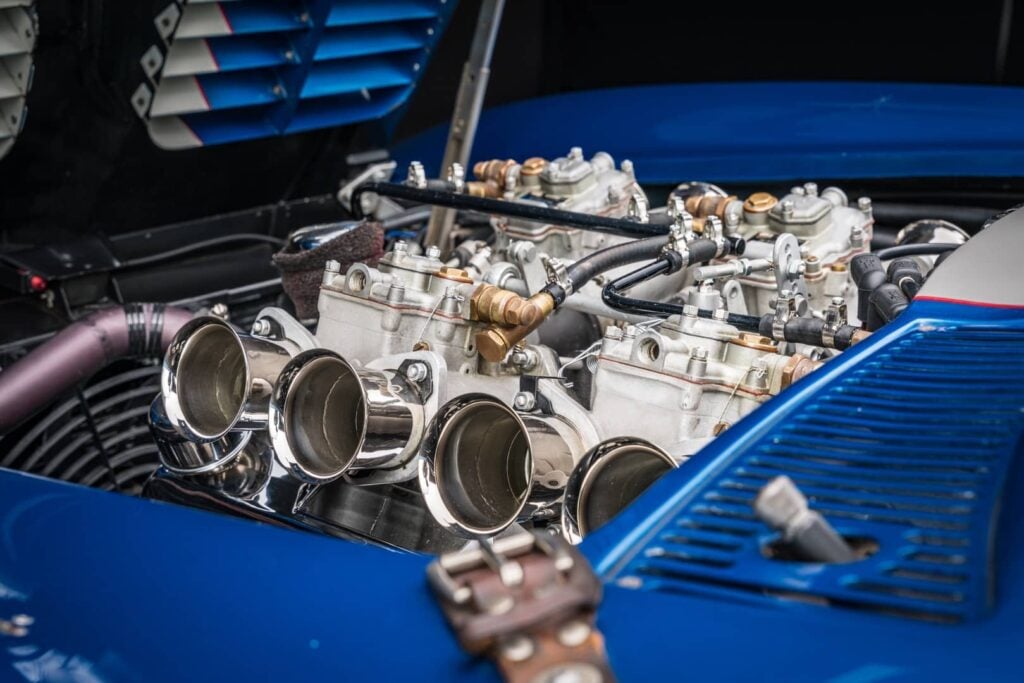
The engine was equally aggressive: a hand-built all-aluminum 377 cubic-inch V8 with hemispherical heads and 58mm Weber carburetors producing an estimated 550 horsepower. The first car was completed in November 1962 and immediately tested at Sebring.
The plan called for 125 cars to achieve FIA homologation. Only five were built before GM shut it down.
GM Pulls the Plug - Five Cars Survive
When GM’s CEO Frederic Donner discovered the program, he ordered it halted immediately in late 1962. Duntov was reportedly instructed to destroy the cars. Instead, he found a way to quietly transfer the five completed Grand Sports into private hands – preserving them against all odds.
Because the homologation target of 125 cars was never reached, the Grand Sports couldn’t compete in GT class as intended. They were reclassified into C Modified – a class for which they were never designed. Still, they raced.
Nassau Speed Week: The Grand Sport vs. The Cobra
The Grand Sport’s defining moment came in December 1963 at Nassau Speed Week in the Bahamas – an event operated outside FIA rules, which meant the cars could finally face the Shelby Cobras head-on.
Three Grand Sports, entered by owner John Mecom and driven by Roger Penske, Jim Hall, Dick Thompson, John Cannon, and Augie Pabst, delivered a decisive result: the Corvettes dominated the Cobras and embarrassed several European marques in the process. In 1964, Roger Penske drove a Grand Sport to victory in the Nassau Trophy Race – the program’s crowning achievement.
The five surviving cars – three coupes and two roadsters (chassis 001 and 002 were converted from coupes during their racing careers) – are today considered among the most important American competition cars ever built.
Corvette Grand Sport Collector Value: The Original Five
No Corvette Grand Sport for sale listing will ever rival the five original 1963 factory cars. Each is a one-of-a-kind artifact with a documented chain of custody, authenticated race history, and an inseparable connection to Zora Arkus-Duntov’s secret program.
Chassis 002 – the unrestored roadster raced by Roger Penske – failed to sell at $4.9 million at RM Auctions’ Arizona sale in January 2009, with the reserve set even higher.
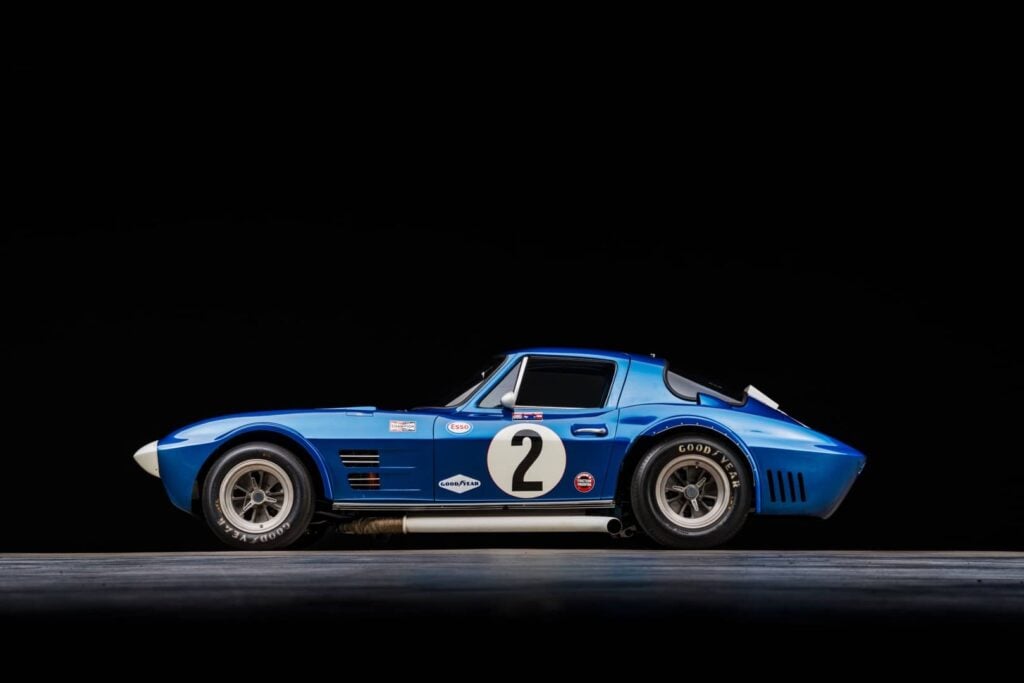
In July 2026, Grand Sport chassis 003 – the first of the original coupes – was consigned to RM Sotheby’s Monterey auction (August 13-15, 2026) with a pre-sale estimate of $11 million to $13 million. RM Sotheby’s describes it as a car whose “rarity, engineering, and enduring mystique” elevate it “beyond the world of Corvettes” – making it the centerpiece of one of the most anticipated collector car auctions of the year.
What drives these extraordinary valuations is the convergence of four factors that almost never align: extreme physical rarity (five examples, worldwide), factory provenance from a program that officially never existed, documented race history at the highest levels of American motorsport, and an unbroken connection to one of automotive history’s most beloved engineers.
Where to Find a Grand Sport Today
For the five original 1963 factory cars, Corvette Grand Sport auction appearances are extraordinarily rare events – and based on the $11-13 million estimate attached to chassis 003 at Monterey 2026, the ceiling for these cars remains very much an open question.
The Corvette Grand Sport is more than a performance variant – it is the living proof that one engineer’s defiance of corporate policy created an American racing legend that six decades of history have only made more valuable.